Updated 18 July 2026 · Specifications and Amazon availability checked 18 July 2026 · Written by MKB Team
A great drip coffee maker gets two things right that cheap ones miss: it brews hot enough, ideally between 195 and 205 degrees Fahrenheit, and it saturates the grounds evenly instead of dribbling water down one side. Get those right and even ordinary beans taste noticeably better. We compared five machines from a handmade SCA-certified brewer to a flexible budget model, and matched each to how you drink coffee. We did not run a brew-temperature probe test ourselves, so our recommendations draw on manufacturer specifications, SCA certification data and owner feedback.
For the best cup with the least fuss, the Technivorm Moccamaster is the one to buy: SCA certified, brewing at the correct temperature into a glass carafe, and built to last a decade. Want to fine-tune every variable? The Breville Precision Brewer. On a budget, the Ninja 12-Cup delivers real flexibility for less.
- Best overall: Technivorm Moccamaster KBGV Select · Check price
- Best customizable: Breville Precision Brewer · Check price
- Best large-capacity value: Cuisinart PerfecTemp 14-Cup · Check price
- Best budget: Ninja 12-Cup Programmable · Check price
- Best mid-range thermal: OXO Brew 9-Cup · Check price
Affiliate Disclosure: As an Amazon Associate we earn from qualifying purchases. This never changes our rankings, and the specifications below come from each manufacturer’s current listing.
Side-by-Side Comparison
| Coffee maker | SCA certified | Carafe | Capacity | Best for | Buy |
|---|---|---|---|---|---|
| Moccamaster KBGV | Yes | Glass | 10 cup | The best all-round cup | Check price |
| Breville Precision | Yes | Glass/thermal | 12 cup | Fine-tuning every variable | Check price |
| Cuisinart PerfecTemp | No | Glass | 14 cup | Large batches on a budget | Check price |
| Ninja 12-Cup | No | Glass | 12 cup | Flexible brewing for less | Check price |
| OXO Brew 9-Cup | Yes | Thermal | 9 cup | Hot coffee that stays hot | Check price |
How We Evaluated These Picks
We are a research desk, not a coffee lab, so we did not probe each brew basket. We looked at whether the machine is SCA certified for temperature and brew time, how evenly the shower head saturates the grounds, the carafe type and capacity, and how easy each is to program and clean, then weighed owner feedback.
What SCA Certification Actually Means
The Specialty Coffee Association certifies home brewers that hit the details professionals care about: brewing water between roughly 195 and 205 degrees Fahrenheit, holding the right contact time, and saturating the grounds evenly. A certified machine like the Moccamaster, Breville or OXO here takes the guesswork out of a good cup. It does not guarantee you will taste a difference with stale beans, but it removes the machine as the weak link.
Many cheaper makers brew a little cool or pulse water unevenly, which under-extracts the coffee and leaves it weak or sour. That does not make them bad buys, the Cuisinart and Ninja here are capable and flexible, it just means the cup depends more on your grind and ratio. If you are chasing the best possible drip coffee, start with a certified brewer.
Best Overall: Technivorm Moccamaster KBGV Select

Best for: Anyone who wants the best drip cup with almost no fuss and a machine that lasts
Specifications
| SCA certified | Yes |
| Carafe | Glass, 10 cup |
| Brew time | 4 to 6 min |
| Heating | Copper element |
| Warranty | 5 years |
| Origin | Netherlands |
The Moccamaster is the drip machine serious coffee drinkers keep recommending. It is handmade in the Netherlands, SCA certified, and brews at the correct temperature through a copper heating element, finishing a batch in about four to six minutes so the coffee is hot and fully extracted. The KBGV Select adds a half or full carafe switch that adjusts the brew for smaller batches, and the whole thing is built to run for a decade with replaceable parts.
It is expensive, it uses a simple glass carafe on a hot plate rather than a programmable timer, so there is no wake-up scheduling, and it takes vertical space. But for pure cup quality and longevity it is the standout. Who should skip it: anyone who needs a programmable start or a large thermal carafe. Pros: SCA-certified brewing, superb cup, built to last. Cons: pricey, no timer, glass carafe only.
Model reviewed: Technivorm Moccamaster KBGV Select 10-Cup, ASIN B093DYPBYR
Best Customizable: Breville Precision Brewer
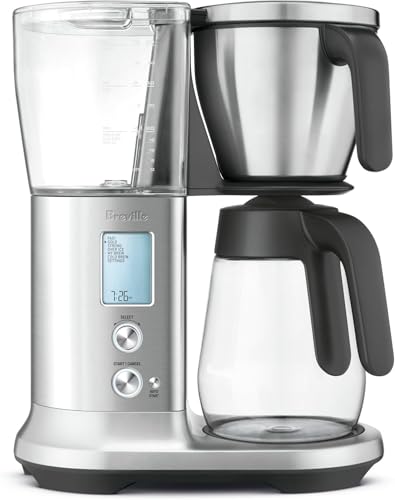
Best for: Coffee geeks who want to control temperature, flow rate and bloom
Specifications
| SCA certified | Yes |
| Carafe | Glass (thermal option) |
| Adjustable | Temp, flow, bloom |
| Modes | 6 incl. cold brew |
| Capacity | 12 cup |
| Best for | Customizing |
The Breville Precision Brewer is the thinking cook’s drip machine. It is SCA certified but goes further, letting you adjust brew temperature, flow rate and bloom time, with six preset modes including gold cup, fast, strong, iced and even a cold brew and a pour-over adapter. That makes it the most flexible machine here, able to match different beans and tastes precisely.
All that control means a learning curve and a premium price, and it is a large machine on the counter. The reward is that once dialled in it brews as well as anything and adapts to whatever you buy. Who should skip it: anyone who just wants to press a button and walk away. Pros: SCA certified, deeply adjustable, multiple brew modes. Cons: complex, expensive, large footprint.
Model reviewed: Breville BDC400BSS Precision Brewer, ASIN B07DMBYH4S
Best Large-Capacity Value: Cuisinart PerfecTemp 14-Cup

Best for: Big households and offices that want a large, programmable pot for less
Specifications
| SCA certified | No |
| Carafe | Glass, 14 cup |
| Programmable | Yes |
| Extras | Brew strength, self-clean |
| Capacity | 14 cup |
| Best for | Large batches |
The Cuisinart PerfecTemp is the practical family choice. Its 14-cup glass carafe is the largest here, it is fully programmable so coffee is ready when you wake, and a brew-strength control lets you push it bolder. Self-clean and a hot-plate temperature setting round out a genuinely useful feature set at a mid-range price.
It is not SCA certified, so the brew temperature runs a touch cooler than the certified machines, and the extraction depends more on your grind and ratio. Some owners note a plastic taste at first that fades after a few brews and a rinse. But for a big, programmable pot on a budget it is hard to beat. Who should skip it: anyone chasing certified brew quality. Pros: large capacity, fully programmable, strength control, good value. Cons: not SCA certified, brews slightly cool, initial plastic taste.
Model reviewed: Cuisinart 14-Cup Programmable PerfecTemp, ASIN B00MVWGQX0
Best Budget: Ninja 12-Cup Programmable
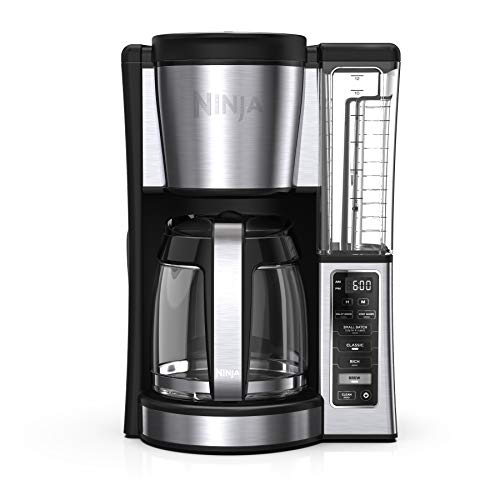
Best for: Value seekers who still want brew-style flexibility
Specifications
| SCA certified | No |
| Carafe | Glass, 12 cup |
| Brew styles | Classic and Rich |
| Programmable | Yes |
| Warming | Adjustable |
| Best for | Budget flexibility |
The Ninja 12-Cup punches above its price with real flexibility. Two brew styles, classic and rich, let you choose a standard cup or a bolder, more concentrated brew for milk drinks, and an adjustable warming plate keeps coffee drinkable without scorching it. It is fully programmable and holds a family-sized 12 cups.
Like the Cuisinart it is not SCA certified, so the machine will not do all the work for you, and the all-plastic build feels less premium. But the brew-style options and low price make it one of the most versatile budget makers around. Who should skip it: anyone who wants certified temperature or a thermal carafe. Pros: two brew styles, programmable, big capacity, cheap. Cons: not SCA certified, plastic build, glass carafe on a hot plate.
Model reviewed: Ninja 12-Cup Programmable Coffee Brewer, ASIN B07S98411N
Best Mid-Range Thermal: OXO Brew 9-Cup
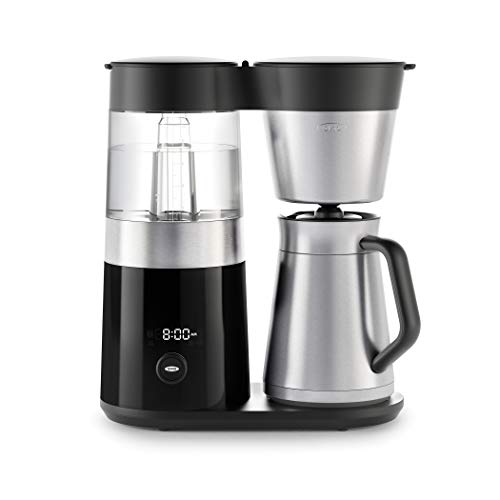
Best for: Slow sippers who want certified coffee that stays hot for hours
Specifications
| SCA certified | Yes |
| Carafe | Thermal, 9 cup |
| Shower head | Rainmaker, even saturation |
| Controls | Single dial |
| Keeps hot | Hours |
| Best for | Thermal |
The OXO Brew 9-Cup is the sweet spot between quality and price. It is SCA certified, so it brews at the right temperature, and its rainmaker shower head saturates the grounds evenly for a balanced cup. Crucially it brews into an insulated thermal carafe rather than a hot plate, so the coffee stays hot for hours without cooking and turning bitter, and a single intuitive dial keeps it simple.
Its 9-cup capacity is smaller than the family machines, and the thermal carafe means you cannot see how much is left. But for certified coffee that stays hot without a scorching hot plate, it is excellent value. Who should skip it: large households needing 12 to 14 cups. Pros: SCA certified, thermal carafe keeps coffee hot, simple to use. Cons: smaller capacity, cannot see level in carafe.
Model reviewed: OXO Brew 9-Cup Coffee Maker, ASIN B00YEYKK8U
Which Coffee Maker Should You Buy?
Best for the finest cup
The Technivorm Moccamaster or Breville Precision Brewer, both SCA certified. The Moccamaster is simpler; the Breville lets you fine-tune everything.
Best for a big household
The Cuisinart PerfecTemp at 14 cups, or the Ninja at 12 cups, both programmable so coffee is ready when you wake.
Best for coffee that stays hot
The OXO Brew 9-Cup, which brews into an insulated thermal carafe rather than a hot plate that slowly cooks the coffee.
Best for tinkerers
The Breville Precision Brewer, with adjustable temperature, flow and bloom plus multiple brew modes.
Best on a budget
The Ninja 12-Cup for flexible brewing at a low price, or the Cuisinart if you want the largest capacity.
Buying Guide
Look for SCA certification
Certified machines brew between about 195 and 205 degrees and saturate evenly, removing the machine as the weak link. The Moccamaster, Breville and OXO here are certified.
Glass hot plate or thermal carafe
A hot plate keeps coffee hot but slowly cooks it bitter; a thermal carafe holds heat without cooking. Choose thermal if you sip over hours.
Match capacity to your household
Cup ratings are small 5-ounce cups, so a 12-cup pot is roughly eight mugs. Buy for how much you actually brew at once.
Programmable start is worth it
A timer that has coffee ready when you wake is a small feature that transforms mornings. All but the Moccamaster here offer it.
Care and Descaling
- Descale every one to three months with a descaling solution or diluted vinegar, then run clean water cycles to rinse.
- Rinse a new machine with a few water-only brews to clear any plastic taste.
- Empty and dry the carafe and basket after use to prevent stale oils and mould.
- Use filtered water to slow scale buildup and improve the taste of the coffee.
Frequently Asked Questions
What temperature should coffee brew at?
Between about 195 and 205 degrees Fahrenheit. SCA-certified machines like the Moccamaster, Breville and OXO hit this range; many cheaper makers brew cooler, which under-extracts and weakens the cup.
Is an SCA-certified coffee maker worth it?
If you want the best cup with the least effort, yes. Certification means the machine brews at the right temperature and saturates evenly, so the coffee depends on your beans and grind, not a weak machine.
Glass or thermal carafe?
A glass carafe on a hot plate keeps coffee hot but slowly cooks it bitter. A thermal carafe, like the OXO’s, holds heat without cooking, so it is better if you drink over a couple of hours.
How many cups do I actually get?
Cup ratings use small 5-ounce cups, so a 12-cup maker yields roughly eight normal mugs. Size up if you brew for a family or office.
How often should I descale a coffee maker?
Every one to three months depending on your water hardness. Scale lowers brew temperature and slows the machine, so regular descaling protects both the taste and the maker.
Sources and References
Specifications and SCA certification were checked against each manufacturer’s Amazon listing and the Specialty Coffee Association’s certified home brewer list on 18 July 2026 (Technivorm, Breville, Cuisinart, Ninja and OXO).
Final Verdict
For the best drip coffee with the least fuss, the Technivorm Moccamaster is the buy: SCA-certified brewing, a superb cup and a machine that lasts a decade. The Breville Precision Brewer is the choice if you like to fine-tune temperature and flow, the OXO Brew 9-Cup keeps certified coffee hot in a thermal carafe, and the Cuisinart and Ninja deliver large, programmable, flexible brewing on a budget. Decide whether you want certified simplicity, deep control or big-batch value, and pick the carafe that matches how long your coffee sits.
Related Guides
- Is an espresso machine worth it?
- How long do coffee makers last?
- How to use a moka pot
- The best coffee scales
