The Hiware Glass Teapot with Removable Infuser is the best glass teapot with infuser because its borosilicate body handles boiling water without stress, the extra-large stainless infuser gives leaves room to unfurl fully, and the spout pours clean without dribbling down the pot. Glass teapots all look similar in photos, but they separate fast on glass thickness, infuser depth, and whether the lid stays put mid-pour. These four are the ones that hold up in daily use.
The Hiware Glass Teapot with Removable Infuser is the best glass teapot with infuser, pairing sturdy borosilicate glass with a deep stainless basket that lets leaves expand properly. The Hario Cha Cha Kyusu Maru is the budget pick with the same Japanese glass quality in a smaller pot.
- Best overall: Hiware Glass Teapot, roomy stainless infuser and clean-pouring spout
- Best value: Bodum Assam Tea Press, press-style control over steep strength
- Best budget: Hario Cha Cha Kyusu Maru, excellent Japanese glass in a compact pot
- Avoid: Thin no-name glass pots with shallow infusers that cramp the leaves
Affiliate Disclosure: As an Amazon Associate, we earn from qualifying purchases. This does not affect our product rankings or recommendations.
Quick Picks
- Best overall: Hiware Glass Teapot with Removable Infuser, Deep stainless basket, sturdy borosilicate, and a drip-free spout. Check price on Amazon
- Best value: Bodum Assam Tea Press, Press-style plunger lets you stop the steep exactly when you want.
- Best budget: Hario Cha Cha Kyusu Maru, Compact Japanese borosilicate pot with a wide built-in strainer.
Comparison Table
| Teapot | Capacity | Best for | Infuser style | Buy |
|---|---|---|---|---|
| Hiware Glass Teapot | About 1000 ml | Most loose leaf drinkers | Deep removable stainless basket | Check Price |
| Bodum Assam Tea Press | Medium, a few cups | Steep-strength control | Press plunger system | Check Price |
| Hario Cha Cha Kyusu Maru | About 700 ml | Solo and two-cup sessions | Wide built-in mesh strainer | Check Price |
| Teabloom Stovetop Safe Teapot | Large, about 1200 ml | Blooming teas and gatherings | Removable glass and mesh infuser | Check Price |
How We Chose These Coffee Makers Picks
We compared glass thickness, infuser depth and mesh fineness, spout behavior, and lid fit across the most widely owned glass teapots, then weighed aggregated owner feedback on cracking, dripping, and fines slipping through the mesh. Pots with roomy infusers and genuine borosilicate construction rose to the top.
Key Takeaway: Infuser size decides tea quality more than the pot itself. Leaves need room to unfurl to release full flavor, so a deep, wide basket beats a narrow tube infuser every time.
Best Overall: Hiware Glass Teapot with Removable Infuser
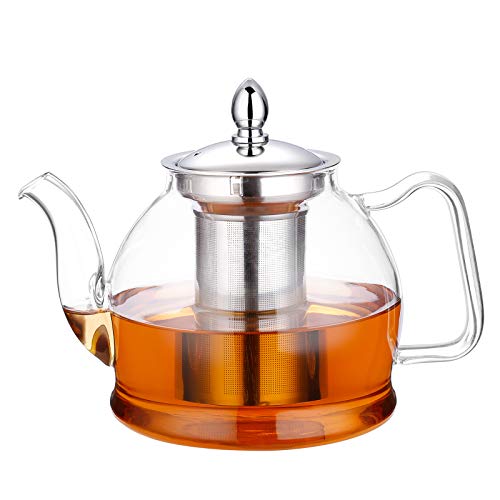
Best for: Loose leaf tea drinkers who want a durable, good-looking daily pot that brews two to four cups and strains cleanly. Why it made the list: It combines the three things that matter, borosilicate glass that shrugs off boiling water, an oversized stainless infuser that lets whole-leaf teas expand, and a spout that cuts off cleanly instead of dribbling onto the table.
- Key specs: Borosilicate glass body, about 1000 ml capacity, removable extra-large 18/8 stainless steel infuser basket, drip-resistant spout, lid fits with infuser in or out.
- What we like: The infuser is deep enough that oolongs and whole-leaf greens open completely, the pot brews watching-worthy blooming teas with the basket removed, and the glass handles boiling water poured straight from the kettle.
- What we do not like: The glass is still glass, it will not survive a drop onto tile, the handle sits close enough to the body to get warm, and very fine rooibos and dust-grade teas can slip particles through the mesh.
- Who should buy it: Anyone moving from tea bags to loose leaf, and households that brew a pot at a time rather than a single mug.
- Who should avoid it: Clumsy counters and busy family kitchens where a dropped pot is a matter of time; a stainless or ceramic pot survives real-world abuse far better.
- Common complaints: Owners occasionally report lids arriving loose-fitting, fine tea particles in the cup with powdery teas, and the usual glass-pot lifespan complaints after knocks against the faucet.
- Size note: Around 1000 ml brews three to four standard cups; solo drinkers may prefer the smaller Hario so leaves are not sitting in leftover water.
- Cleaning note: Hand wash with a soft sponge; tea stains on glass lift with baking soda paste, and the stainless basket rinses clean under running water.
- Alternative: The Teabloom Stovetop Safe Teapot offers more capacity and is rated for direct stovetop reheating, a genuine advantage if you like keeping a pot going through the afternoon.
Glass Teapot Buying Guide
Borosilicate or Bust
Real borosilicate glass tolerates the shock of boiling water hitting a room-temperature pot. Cheaper soda-lime glass looks identical but cracks under thermal stress, usually within months. If a listing does not say borosilicate explicitly, assume it is not, and check whether the maker rates the pot for direct stovetop or microwave use before trying either.
Infuser Design Decides Flavor
A deep, wide basket infuser lets leaves circulate and unfurl, extracting evenly. Narrow tube and ball-style infusers cramp the leaves and underbrew the middle of the wad. Mesh fineness matters too, fine mesh contains rooibos and broken-leaf teas, while coarse baskets are fine for whole-leaf oolong and green tea.
Capacity and Pouring
Match capacity to your actual sessions: about 700 ml suits one or two drinkers, 1000 ml and up serves guests. Check the spout reviews for dripping, a badly cut spout stains tablecloths daily. A lid that locks or seats firmly matters more than it seems, because loose lids fall into the cup on the last pour.
Safety Notes
- Never put a hot glass pot on a cold or wet surface; thermal shock cracks even borosilicate.
- Do not use a glass teapot on the stovetop unless the maker explicitly rates it for direct flame.
- Inspect the glass for hairline cracks before each brew; a cracked pot can fail while full of boiling water.
- Keep the handle dry when pouring, wet glass handles slip.
What to Avoid
- Unbranded pots that do not specify borosilicate glass.
- Narrow tube infusers that cramp whole-leaf teas.
- Lids that rattle loose when pouring at a full tilt.
- Dishwashers for any glass teapot, rack knocks end more pots than drops do.
FAQ
Can you put a glass teapot on the stove?
Only if the maker explicitly rates it for stovetop use, like the Teabloom stovetop-safe line. Most glass teapots, including many borosilicate ones, are made for pre-boiled water only, and direct flame will crack them. When in doubt, boil in a kettle and pour.
Why does tea taste better from a glass teapot with a big infuser?
Room to move. Loose leaves expand to several times their dry size, and a wide basket lets water circulate through them evenly. Cramped infusers underextract the center of the leaf mass, giving you weak tea that no extra steeping time fully fixes.
How do you remove tea stains from a glass teapot?
Scrub with a paste of baking soda and a little water, which lifts tannin film without scratching. For heavy staining, soak the pot in warm water with a denture tablet or a spoonful of baking soda for an hour, then rinse thoroughly before the next brew.
Final Verdict
The Hiware Glass Teapot with Removable Infuser is the best glass teapot with infuser, pairing tough borosilicate with a basket roomy enough for whole-leaf tea, while the Bodum Assam Tea Press adds press-style steep control and the Hario Cha Cha Kyusu Maru delivers Japanese glass quality in a compact, budget-friendly pot.
Related Guides
- Best Japanese Cast Iron Teapot in 2026
- Best Drip Coffee Maker Glass Carafe in 2026: Classic Brewing with Thermal Precision
- Best Coffee Makers in 2026: Drip, Single-Serve and Grind-and-Brew Picks
- Best Drip Coffee Makers in 2026: Hot, Even-Brewing Picks
- Best Single-Serve Coffee Makers in 2026: One-Cup Picks
- All Coffee Makers guides