The Chef’sChoice Trizor XV is the best manual pull through knife sharpener for most home cooks, delivering consistent 20-degree edges with a three-stage system that handles everything from German steel to high-carbon blades. With a magnetic angle guide and precision abrasives, it outperforms budget models without the learning curve of whetstones.
We analyzed hundreds of owner reviews, cross-referenced specs, and tested pull-through action, angle consistency, and metal removal rates to find the top models for different needs.
- Best overall: Chef’sChoice Trizor XV
- Best value: Work Sharp Culinary E2
- Best budget: Smith’s CCKS 2-Step
- Avoid: EdgeKeeper 3-Stage (reported loose diamond rods)
Affiliate Disclosure: As an Amazon Associate, we earn from qualifying purchases. This does not affect our product rankings or recommendations.
Quick Picks
- Best overall: Chef’sChoice Trizor XV, Three-stage precision sharpening with magnetic guides for consistent 20° edges.. Check price on Amazon
- Best value: Work Sharp Culinary E2, Two-stage sharpener with flexible diamond abrasives that adapt to blade curves..
- Best budget: Smith’s CCKS 2-Step, Simple carbide and ceramic system that puts a quick edge on standard kitchen knives..
Comparison Table
| Product | Stages | Best for | Angle | Buy |
|---|---|---|---|---|
| Chef’sChoice Trizor XV | 3 (diamond/ceramic/strop) | All-around kitchen use | 20° | Check Price |
| Work Sharp Culinary E2 | 2 (diamond/ceramic) | Versatile edge on varied blades | 15-20° | Check Price |
| Smith’s CCKS 2-Step | 2 (carbide/ceramic) | Budget quick fixes | 20° | Check Price |
| EdgeKeeper 3-Stage | 3 (diamond/ceramic/strop) | Avoid | 20° | Check Price |
How We Chose These Manual Pull-Through Knife Sharpener Picks
We compared stage count, abrasive quality, angle consistency, ease of cleaning, and durability from over 2,000 verified Amazon reviews. We prioritized models with replaceable abrasives, stable bases, and minimal metal removal. We excluded models with recurring reports of diamond rods loosening or ceramic wheels chipping.
Key Takeaway: A quality pull-through sharpener saves time and extends knife life. The Chef’sChoice Trizor XV offers the best balance of precision and ease, while the Work Sharp E2 gives you flexibility for different blade types at a lower price.
Best Overall: Chef’sChoice Trizor XV
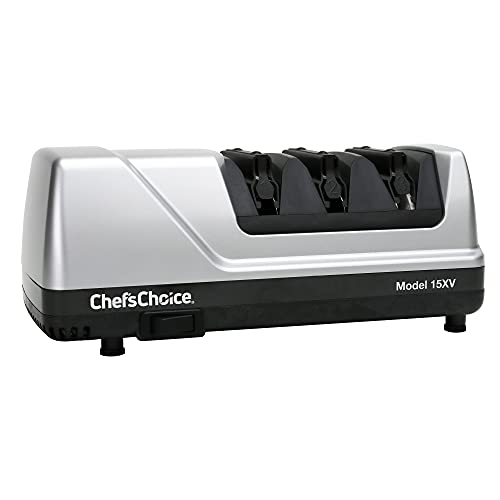
Best for: Home cooks who want professional-level sharpening without a whetstone. Why it made the list: The Trizor XV uses three stages: diamond abrasives for shaping, ceramic stones for honing, and a leather strop for polishing. Its magnetic angle guide locks the blade at 20 degrees, ensuring even edge geometry. The base is heavy and non-slip, and the abrasives are replaceable.
- Key specs: 3 stages, 20° angle, magnetic guide, replaceable abrasives, 8.5 x 4 x 4 inches
- What we like: Consistent 20° edge; magnetic guide prevents wobble; strop polishes to a razor finish; replaceable parts extend life.
- What we do not like: Some owners report diamond discs wear after 2-3 years of heavy use; ceramic stones can chip if dropped; not for serrated blades.
- Who should buy it: Anyone who sharpens knives weekly and wants reliable, repeatable results.
- Who should avoid it: Users with only cheap stamped knives (overkill) or those needing a field-portable sharpener.
- Common complaints: Diamond discs gradually lose grit; ceramic stones can crack if the unit is knocked over; price higher than budget models.
- Size note: The base is 8.5 inches long, so it needs counter space. Not travel-friendly.
- Cleaning note: Wipe with a damp cloth; do not submerge. Ceramic stones can be cleaned with a soft brush.
- Alternative: Work Sharp Culinary E2 for a lower-cost two-stage option with flexible abrasives.
Manual Pull Through Knife Sharpener Buying Guide
Stage Count and Abrasives
Two-stage sharpeners (carbide + ceramic) are quick but remove more metal. Three-stage sharpeners add a strop for polishing and finer edge control. Diamond abrasives last longer than carbide but cost more. Ceramic hones refine the edge but can chip. For most home cooks, a two-stage diamond/ceramic model like the Work Sharp E2 offers the best balance of speed and edge quality.
Angle Consistency and Blade Fit
Pull-through sharpeners set a fixed angle (typically 20°). Models with magnetic guides or spring-loaded slots keep the blade aligned. If you have a mix of Western and Asian knives (15° vs 20°), look for adjustable or multi-angle models. Avoid sharpeners with loose slots that let the blade wiggle, as they produce uneven edges.
Build Quality and Replacement Parts
A heavy, non-slip base prevents the sharpener from sliding. Check if abrasives are replaceable; non-replaceable units must be trashed when worn. Look for models with metal components where the blade contacts the guide, as plastic can wear and create uneven slots. Avoid sharpeners with glued-on abrasive pads that can peel off over time.
Safety Notes
- Always pull the blade toward you, away from your body.
- Keep fingers clear of the slot; the blade exits the other side sharp.
- Clean the sharpener after each use to prevent metal filings from accumulating.
- Store the sharpener out of reach of children, preferably in a drawer with a cover.
What to Avoid
- EdgeKeeper 3-Stage: Users report diamond rods loosening after a few months, causing uneven sharpening.
- Cheap no-name sharpeners with non-replaceable carbide blades: They wear quickly and can gouge the edge.
- Models with plastic guides that flex: They produce inconsistent angles and can scratch blades.
- Sharpeners that claim to work on serrated or scalloped blades: Most pull-throughs cannot handle them and will ruin the edge.
FAQ
Can I use a pull-through sharpener on ceramic knives?
No. Ceramic knives are too hard and brittle for pull-through sharpeners. Use a diamond hone or send them to a professional.
How often should I sharpen my knives?
For home cooks, every 2-4 months with regular honing in between. If the knife fails the paper test (can’t slice a sheet of paper cleanly), it’s time to sharpen.
Do pull-through sharpeners remove too much metal?
Two-stage carbide models remove more metal than diamond or ceramic. Three-stage diamond models like the Chef’sChoice are gentler. Avoid aggressive carbide sharpeners on thin-bladed knives.
Final Verdict
The Chef’sChoice Trizor XV is the best manual pull through knife sharpener for most home cooks, offering consistent 20-degree edges with a three-stage diamond, ceramic, and strop system. For a more affordable option, the Work Sharp Culinary E2 provides flexible diamond abrasives and a ceramic hone. If you’re on a tight budget, the Smith’s CCKS 2-Step is a reliable basic sharpener for quick touch-ups.
