The Zojirushi Neuro Fuzzy NS-ZCC10 is the best Japanese rice cooker for most kitchens because its fuzzy logic microcomputer adjusts temperature and timing on the fly, turning out consistently plump, evenly cooked rice whether you make white, sushi, or brown rice. Japanese brands like Zojirushi and Tiger dominate this category for good reason, their cookers are engineered around rice texture rather than speed alone, and they last for many years of daily use.
The Zojirushi Neuro Fuzzy NS-ZCC10 is the best Japanese rice cooker, combining fuzzy logic cooking with settings for every common rice type. The Tiger JBV-A10U delivers most of that quality for noticeably less.
- Best overall: Zojirushi Neuro Fuzzy NS-ZCC10
- Best value: Tiger JBV-A10U Micom Rice Cooker
- Best budget: Zojirushi NHS-06 Rice Cooker
- Avoid: Bargain cookers with a single crude heat switch and thin pans, they scorch the bottom layer and cannot handle brown rice
Affiliate Disclosure: As an Amazon Associate, we earn from qualifying purchases. This does not affect our product rankings or recommendations.
Quick Picks
- Best overall: Zojirushi Neuro Fuzzy NS-ZCC10, Fuzzy logic cooking with dedicated settings for white, sushi, porridge, and brown rice. Check price on Amazon
- Best value: Tiger JBV-A10U Micom Rice Cooker, Reliable micom cooking and a steaming plate for cooking a side dish at the same time.
- Best budget: Zojirushi NHS-06 Rice Cooker, Simple one-switch 3 cup cooker with genuine Zojirushi build quality.
Comparison Table
| Rice cooker | Capacity | Best for | Technology | Buy |
|---|---|---|---|---|
| Zojirushi Neuro Fuzzy NS-ZCC10 | 5.5 cups uncooked | Households wanting the best texture | Micom fuzzy logic | Check Price |
| Tiger JBV-A10U | 5.5 cups uncooked | Value-focused families | Micom with steam plate | Check Price |
| Zojirushi NHS-06 | 3 cups uncooked | Singles and couples | Conventional one switch | Check Price |
| Zojirushi NP-HCC10 | 5.5 cups uncooked | Brown rice fans, upgraders | Induction heating | Check Price |
How We Chose These Japanese Rice Cooker Picks
We compared heating technology, cooking programs, inner pan quality, and keep warm performance across the Japanese rice cooker lineups, then weighed long-term owner feedback on durability and texture consistency. Models with common lid or coating failures were excluded.
Key Takeaway: The jump from a basic on-off cooker to a micom fuzzy logic model is the single biggest upgrade in rice texture. Induction heating adds another smaller improvement, mainly for brown rice and mixed grains.
Best Overall: Zojirushi Neuro Fuzzy NS-ZCC10
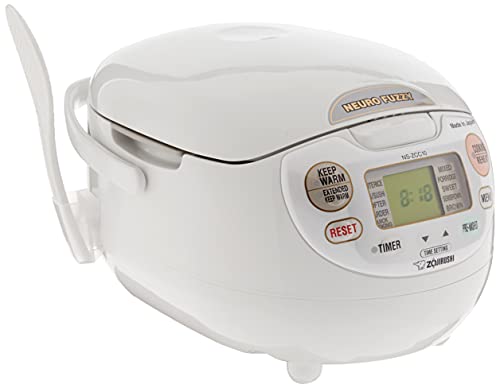
Best for: Households that eat rice several times a week and want consistently excellent texture across white, sushi, porridge, and brown rice without babysitting the pot. Why it made the list: The Neuro Fuzzy earned its reputation by actually adjusting the cook, its microcomputer senses how the batch is progressing and tweaks heat and timing rather than running a fixed cycle. Rice comes out plump and separate, brown rice is genuinely good instead of chewy, and the extended keep warm holds rice for hours without drying it into a puck. It has been a category benchmark for years and owner loyalty reflects that.
- Key specs: 5.5 cup uncooked capacity, fuzzy logic micom control, menu settings for white, softer or harder, sushi, porridge, brown, and quick cooking, extended keep warm, retractable power cord.
- What we like: Extremely consistent texture batch after batch, real brown rice and porridge programs that work, removable inner lid for cleaning, delay timer for waking up to fresh rice.
- What we do not like: It is slow on the standard cycle, often around an hour with warm-up and steaming, and the exterior styling and interface feel dated for the price.
- Who should buy it: Anyone cooking rice three or more times a week, sushi makers, and households that use keep warm for hours at a time.
- Who should avoid it: Occasional rice eaters and anyone who mostly cooks one cup at a time, small batches sit low in the 5.5 cup pan and a 3 cup cooker does them better.
- Common complaints: Owners mention the long cook times, a melody chime some find loud, and a nonstick pan coating that needs gentle handling with plastic paddles only.
- Size note: Capacity is measured in 180 ml rice cups, so 5.5 cups uncooked yields roughly 10 bowls of cooked rice, plenty for a family of four with leftovers.
- Cleaning note: Wash the inner pan and detachable inner lid after each use and wipe the steam vent, starch buildup there is the usual cause of lid gunk.
- Alternative: The Zojirushi NP-HCC10 if you want induction heating for even better brown rice, or the Tiger JBV-A10U to save money.
Japanese Rice Cooker Buying Guide
Micom vs induction heating
Micom cookers use a bottom heating plate managed by a microcomputer, and they cover most needs very well. Induction models heat the whole pan directly, which gives more even cooking and noticeably better brown rice and mixed grains, at a meaningfully higher cost. If you mostly eat white rice, micom is the sweet spot.
Capacity and cooked rice yield
Japanese cookers measure capacity in 180 ml rice cups of uncooked rice, not standard US cups. A 3 cup model suits one or two people, a 5.5 cup model suits families of three to five, and 10 cup models are for big households or meal preppers. Cookers perform best between about one third and full capacity, so oversizing hurts small batches.
Settings you will actually use
White and quick settings handle daily rice, but the ones worth paying for are brown rice, porridge, and sushi rice, each uses different soak and heat profiles. A delay timer and a good extended keep warm matter more in daily life than a long menu of novelty modes.
Safety Notes
- Keep hands and face away from the steam vent during cooking, the steam can scald.
- Never submerge the cooker body, only the inner pan and inner lid are washable.
- Use the plastic paddle, metal utensils scratch the nonstick pan and shorten its life.
- Plug the cooker directly into a wall outlet rather than a power strip, per manufacturer guidance.
What to Avoid
- Buying a 10 cup cooker for a two-person household, small batches cook worse in oversized pans.
- Cookers without a detachable inner lid, trapped starch turns sour.
- Measuring with a standard US cup, always use the included 180 ml rice cup.
- No-name cookers with thin pans that scorch the bottom layer.
FAQ
Why are Japanese rice cookers so much better than cheap ones?
They control the entire soak, boil, steam, and rest cycle with sensors instead of just boiling until dry. That staged process is what produces plump, evenly hydrated grains, and it is why micom and induction models cost more.
Do I still need to rinse rice?
Yes. Rinsing removes surface starch that otherwise makes rice gluey and leaves residue in the pot. Rinse until the water runs mostly clear, then use the water lines inside the pan for the correct level.
Can these cookers handle brown rice and other grains?
The NS-ZCC10 and NP-HCC10 both have dedicated brown rice programs that soak and cook longer, and they handle mixed grains well. The basic NHS-06 can cook brown rice with extra water but texture is less consistent.
Final Verdict
The Zojirushi Neuro Fuzzy NS-ZCC10 is the best Japanese rice cooker overall, with the Tiger JBV-A10U as the smart value pick and the Zojirushi NP-HCC10 as the induction upgrade for brown rice devotees.
