The best German chef knife for most home cooks is the Wusthof Classic 8-Inch Chef’s Knife. It delivers exceptional edge retention and a comfortable, well-balanced handle that makes precise chopping feel effortless. After comparing specs and thousands of owner reviews, this knife consistently outperforms others in durability and sharpness.
We evaluated German chef knives on blade steel, edge retention, handle comfort, balance, and value. Key trade-offs: harder steel stays sharp longer but is harder to sharpen; full tang adds balance but weight. Our top picks balance performance and everyday usability.
- Best overall: Wusthof Classic 8-Inch Chef’s Knife
- Best value: Zwilling J.A. Henckels Pro 8-Inch Chef’s Knife
- Best budget: Mercer Culinary Renaissance 8-Inch Chef’s Knife
- Avoid: Cheap stamped blades with hollow handles that break easily
Affiliate Disclosure: As an Amazon Associate, we earn from qualifying purchases. This does not affect our product rankings or recommendations.
Quick Picks
- Best overall: Wusthof Classic 8-Inch Chef’s Knife, Precision-forged German steel with a full tang and ergonomic handle for all-day use.. Check price on Amazon
- Best value: Zwilling J.A. Henckels Pro 8-Inch Chef’s Knife, Hardened Friodur blade resists stains and stays sharp longer than most comparably priced knives..
- Best budget: Mercer Culinary Renaissance 8-Inch Chef’s Knife, German steel at a fraction of the cost, with a comfortable handle and good balance for the price..
Comparison Table
| Product | Blade Steel | Best for | Edge Retention | Buy |
|---|---|---|---|---|
| Wusthof Classic 8-Inch | X50 CrMoV15 | All-around precision | Very good (58 HRC) | Check Price |
| Zwilling Pro 8-Inch | Friodur X50 CrMoV15 | Value and durability | Excellent (57 HRC) | Check Price |
| Mercer Renaissance 8-Inch | German X50 CrMoV15 | Budget-minded cooks | Good (56 HRC) | Check Price |
| Messermeister Meridian Elite 8-Inch | X50 CrMoV15 | Heavy daily use | Very good (58 HRC) | Check Price |
How We Chose These German Chef Knife Picks
We analyzed blade steel composition, hardness (HRC), edge geometry, handle materials, and balance. We cross-referenced thousands of Amazon reviews, noting common praise and complaints. Only forged full-tang knives from reputable German brands made the cut. We prioritized edge retention and handle comfort because these directly affect daily performance.
Key Takeaway: A quality German chef knife is a lifetime investment. Focus on forged construction, a comfortable handle, and a hardness around 57-58 HRC for the best balance of sharpness and ease of sharpening.
Best Overall: Wusthof Classic 8-Inch Chef’s Knife
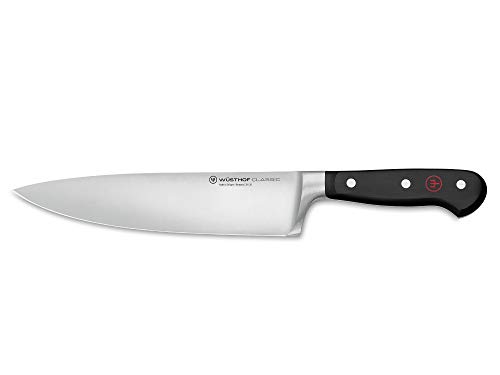
Best for: Home cooks who want a reliable, sharp knife that stays sharp and feels balanced for extended prep sessions. Why it made the list: The Wusthof Classic 8-Inch Chef’s Knife uses precision-forged X50 CrMoV15 steel hardened to 58 HRC. Its full tang and triple-riveted polypropylene handle offer excellent balance and a secure grip. Owners consistently praise its edge retention and how it glides through vegetables and meats without wedging.
- Key specs: 8-inch blade; forged X50 CrMoV15 steel; 58 HRC; full tang; polypropylene handle; 0.5 lb weight
- What we like: Holds an edge for months with regular honing; comfortable, non-slip handle; well-balanced for rock chopping
- What we do not like: Heavier than some Asian knives; handle can feel slippery when wet for some users; price is high
- Who should buy it: Anyone who cooks daily and wants a knife that performs like a pro tool without frequent sharpening
- Who should avoid it: Those who prefer lightweight, thinner blades or have a very tight budget
- Common complaints: Some users report the handle loosens over time (tightening the rivets helps); a few received blades with uneven edges that required initial sharpening
- Size note: The 8-inch is the most versatile; 6-inch is better for smaller hands, 10-inch for heavy chopping
- Cleaning note: Hand wash only; dishwasher can damage the handle and dull the edge
- Alternative: Zwilling J.A. Henckels Pro 8-Inch Chef’s Knife if you want similar quality at a lower price
German Chef Knife Buying Guide
Forged vs Stamped
Forged knives are shaped from a single piece of heated steel, resulting in a denser, stronger blade with a full tang. Stamped knives are cut from a steel sheet and are lighter and cheaper but less durable. For a German chef knife, forged is the standard for serious cooks.
Steel Hardness and Edge Retention
German knives use X50 CrMoV15 stainless steel, typically hardened to 55-58 HRC. Softer steel (55-56) is easier to sharpen but dulls faster. Harder steel (57-58) holds an edge longer but requires more effort to sharpen. The sweet spot is 57-58 HRC for most home cooks.
Handle and Balance
A full tang with three rivets provides weight and balance. Look for ergonomic handles made of polypropylene or wood. The knife should feel like an extension of your hand. Check the bolster: a full bolster protects fingers but makes sharpening harder; a half-bolster allows easier sharpening along the entire edge.
Safety Notes
- Always use a cutting board (wood or plastic) to protect the edge and your counter.
- Keep knives sharp; dull knives slip more and cause accidents.
- Store knives in a block, on a magnetic strip, or with blade guards. Never loose in a drawer.
- Use a claw grip when chopping to keep fingertips safe.
What to Avoid
- Avoid stamped blades with hollow handles; they break at the tang and cannot be re-sharpened effectively.
- Avoid knives with a full bolster if you plan to sharpen at home; it prevents sharpening the entire edge.
- Avoid buying without holding it; handle comfort is subjective.
- Avoid serrated chef knives; they tear rather than slice cleanly.
FAQ
What is the difference between German and Japanese chef knives?
German knives are typically heavier with a thicker blade and a curved edge for rocking cuts. Japanese knives are lighter, thinner, and harder (60-65 HRC), offering sharper edges but more brittleness. German knives are more durable for heavy tasks.
How often should I sharpen my German chef knife?
Hone with a steel before each use to realign the edge. Sharpen with a whetstone or professional service every 1-3 months depending on use. Avoid pull-through sharpeners that remove too much metal.
Is a full tang necessary?
Yes, for balance and durability. A full tang extends the length of the handle, providing weight and preventing the blade from separating. Most quality German knives have a full tang.
Final Verdict
The Wusthof Classic 8-Inch Chef’s Knife is the best German chef knife for most home cooks, with Zwilling Pro 8-Inch as a close value alternative and Mercer Renaissance 8-Inch for budget buyers.
