Updated 18 July 2026 · Specifications and Amazon availability checked 18 July 2026 · Written by MKB Team
A chef knife is the one tool you touch every time you cook, so it is worth getting right. The loudest debate is Japanese versus German: Japanese blades tend to be harder, thinner and sharper, while German blades are softer, heavier and more forgiving. Neither is better in the abstract, they just suit different hands and habits. We compared five chef knives that experienced cooks and published test kitchens keep coming back to, and matched each to the cook it actually fits. We did not run our own edge-retention lab, so our recommendations draw on manufacturer specifications and established knife-testing sources.
For most kitchens the Victorinox Fibrox Pro is the smartest buy: a light, sharp, comfortable knife that costs a fraction of the premium blades and outperforms most of them. Want a Japanese edge? The Mac MTH-80 is the sharpest all-rounder. Prefer German heft? The Wusthof Classic is the workhorse.
- Best overall and best value: Victorinox Fibrox Pro 8-inch (European) · Check price
- Best Japanese knife: Mac MTH-80 8-inch (Japanese) · Check price
- Best German workhorse: Wusthof Classic 8-inch (German) · Check price
- Best budget: Mercer Culinary Millennia 8-inch (European) · Check price
- Best lightweight all-metal: Global G-2 8-inch (Japanese) · Check price
Affiliate Disclosure: As an Amazon Associate we earn from qualifying purchases. This never changes our rankings, and the specifications below come from each manufacturer’s own listing and published knife-testing sources, not from the retailers we link to.
Side-by-Side Comparison
| Chef knife | Origin | Construction | Hardness | Weight | Best for | Buy |
|---|---|---|---|---|---|---|
| Victorinox Fibrox Pro | European (Swiss) | Stamped | ~55-56 HRC | ~7 oz | Value and everyday use | Check price |
| Mac MTH-80 | Japanese | Thin, hollow edge | ~59-61 HRC | ~6.5 oz | Sharpest all-rounder | Check price |
| Wusthof Classic | German | Forged, full tang | ~58 HRC | ~8.5 oz | Heft and durability | Check price |
| Mercer Millennia | European | Stamped | ~55 HRC | ~7 oz | Tight budgets | Check price |
| Global G-2 | Japanese | One-piece steel | ~56-58 HRC | ~6 oz | Lightweight, easy to clean | Check price |
How We Evaluated These Chef Knives
We are a research desk, not an edge-retention lab, so we did not machine-test these blades. We compared the steel and hardness each maker publishes, weighed balance and handle comfort, considered how easy each knife is to sharpen and maintain, and cross-checked against established knife-testing sources and long-run owner feedback.
Japanese vs German Chef Knives, Explained
The difference comes down to steel hardness and geometry. Japanese knives use harder steel, often 59 to 61 on the Rockwell (HRC) scale, ground to a thinner, more acute edge. That makes them feel scary-sharp and glide through vegetables, but the harder edge is more brittle, so it dislikes bones, frozen food and twisting cuts, and it chips more easily if abused. German knives sit softer, around 55 to 58 HRC, with a thicker, more obtuse edge and more weight behind the spine. They are more forgiving, take a beating, and rock through herbs and joints of chicken, but they need honing more often to stay keen.
Practical rule: if you cook a lot of vegetables and value a delicate, precise edge, lean Japanese. If you break down poultry, want a durable do-everything blade, and would rather hone than baby the edge, lean German. The Victorinox and Mercer sit in the softer European camp; the Mac and Global are the Japanese picks; the Wusthof is the classic German forged blade.
Best Overall and Best Value: Victorinox Fibrox Pro 8-inch

Best for: Almost every home cook, and anyone who wants pro performance without the price
Specifications
| Style | European (Swiss), stamped |
| Blade steel | X50CrMoV15 stainless |
| Hardness | ~55-56 HRC |
| Blade length | 8 inches |
| Handle | Fibrox polypropylene, NSF, non-slip |
| Weight | ~7 oz |
| Care | Hand wash recommended (handle is dishwasher-safe) |
The Victorinox Fibrox Pro is the knife most experienced cooks recommend first, and for good reason. It is a stamped Swiss blade in X50CrMoV15 stainless, the same steel class as far pricier European knives, ground thin enough to feel nimble and arrive genuinely sharp. At roughly seven ounces it is light and quick, and the textured Fibrox handle is NSF-rated and stays grippy with wet or greasy hands, which is why so many professional kitchens issue it.
It will not have the mirror polish or the hardened Japanese edge of the premium picks, and the softer steel means you will hone it more often. But it sharpens back to keen in seconds, shrugs off abuse, and costs a fraction of the forged blades. For most people, spending more buys prestige, not better cutting. Who should skip it: collectors who want a heirloom forged knife or the ultra-hard Japanese edge. Pros: superb value, light and sharp, comfortable grippy handle. Cons: plain looks, softer edge needs regular honing.
Model reviewed: Victorinox Fibrox Pro 8-Inch Chef’s Knife, ASIN B008M5U1C2
Best Japanese Knife: Mac MTH-80 8-inch
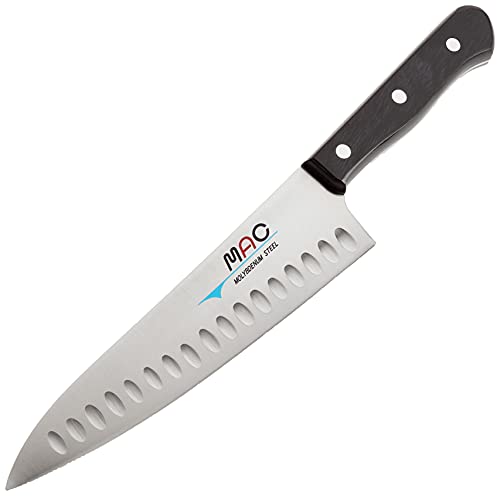
Best for: Cooks who want the sharpest, most precise everyday edge and mostly cut produce
Specifications
| Style | Japanese, thin blade with hollow-edge dimples |
| Blade steel | High-carbon stainless |
| Hardness | ~59-61 HRC |
| Blade length | 8 inches |
| Handle | Pakkawood |
| Weight | ~6.5 oz |
| Care | Hand wash and dry only |
The Mac MTH-80 is a long-standing favourite of test kitchens because it blends Japanese sharpness with just enough real-world toughness. The high-carbon stainless blade runs harder than the European knives, around 59 to 61 HRC, and is ground thin with hollow-edge dimples that help release sticky foods like potatoes. Out of the box it is noticeably sharper than a German knife and holds that edge longer.
The trade-offs are the Japanese ones. The harder, thinner edge is less forgiving, so keep it away from bones and frozen food, and it benefits from careful hand washing and drying. The pakkawood handle is comfortable but plainer than a premium Japanese knife. Who should skip it: anyone who hacks through poultry joints or wants a dishwasher-friendly beater. Pros: exceptional sharpness, good edge retention, light and precise. Cons: pricier, more delicate edge, hand wash only.
Model reviewed: Mac Knife Professional Hollow Edge 8-inch (MTH-80), ASIN B000LY29NQ
Best German Workhorse: Wusthof Classic 8-inch

Best for: Cooks who want a heavier, forgiving forged knife that lasts decades
Specifications
| Style | German (Solingen), forged full tang |
| Blade steel | X50CrMoV15 stainless |
| Hardness | ~58 HRC |
| Blade length | 8 inches |
| Handle | POM synthetic, triple-riveted, full bolster |
| Weight | ~8.5 oz |
| Care | Hand wash and dry only |
The Wusthof Classic is the archetypal German chef knife: a forged, full-tang blade in X50CrMoV15 stainless, hardened to about 58 HRC, with a full bolster and a triple-riveted POM handle. It is made in Solingen and feels it, with a heft that lets the knife do the work when you rock-chop herbs or push through a hard squash. The thicker edge is durable and takes a beating that would chip a Japanese blade.
That weight is the whole point and also the catch: at around 8.5 ounces it can tire smaller hands over a long prep session, and the softer steel needs regular honing to stay keen. The full bolster protects your fingers but makes sharpening the heel slightly fiddlier. Who should skip it: cooks who prefer a light, ultra-sharp blade or have smaller hands. Pros: durable forged build, forgiving edge, excellent balance and heft. Cons: heavy, softer edge, premium price.
Model reviewed: WUSTHOF Classic 8-Inch Chef’s Knife, ASIN B085V653KM
Best Budget: Mercer Culinary Millennia 8-inch
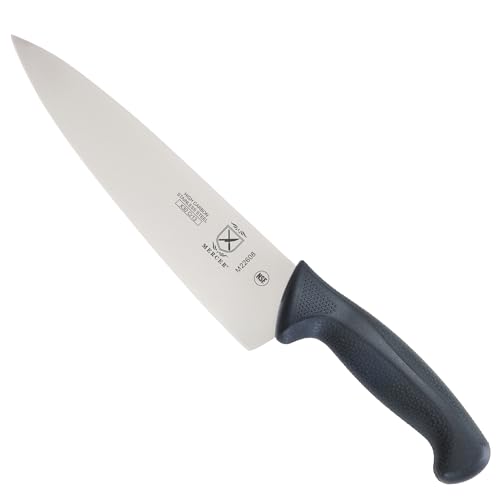
Best for: Beginners, first kitchens, and anyone who wants a capable knife for very little
Specifications
| Style | German-style steel, stamped |
| Blade steel | X50CrMoV15 stainless |
| Hardness | ~55 HRC |
| Blade length | 8 inches |
| Handle | Santoprene, textured, NSF |
| Weight | ~7 oz |
| Care | Hand wash recommended |
The Mercer Millennia is the knife culinary students are often told to buy, because it delivers most of what a beginner needs for a fraction of the cost. It is a stamped blade in German-style X50CrMoV15 stainless with a textured Santoprene handle that is NSF-rated and secure in wet hands. It arrives reasonably sharp and handles everyday chopping, slicing and dicing without complaint.
You are giving up refinement, not capability. The steel is softer, the balance is less polished than the Victorinox, and the finish is basic. But for the price it is hard to beat as a first real chef knife or a spare. Who should skip it: cooks ready to invest once in a knife they will keep for years. Pros: very affordable, grippy safe handle, fully capable. Cons: softer edge, less refined balance, basic feel.
Model reviewed: Mercer Culinary Millennia M22608 8-Inch Chef’s Knife, ASIN B000PS2XI4
Best Lightweight All-Metal: Global G-2 8-inch

Best for: Cooks who want a featherlight Japanese knife with a seamless, easy-to-clean body
Specifications
| Style | Japanese, one-piece all-steel |
| Blade steel | CROMOVA 18 stainless |
| Hardness | ~56-58 HRC |
| Blade length | 8 inches |
| Handle | Seamless dimpled steel, sand-balanced |
| Weight | ~6 oz |
| Care | Hand wash and dry only |
The Global G-2 is unmistakable: a one-piece stainless knife with no joints between blade and handle, so there is nowhere for food to hide, which makes it very hygienic and easy to sanitise. The CROMOVA 18 steel takes a sharp Japanese edge, and the dimpled hollow handle is filled to balance the knife toward the blade. At around six ounces it is the lightest pick here.
The all-metal handle divides people: it is slim and can feel slippery to some hands, especially when wet, so try the grip if you can. The edge is harder than a German knife and prefers careful hand washing. Who should skip it: anyone who wants a warm, contoured handle or a heavier blade. Pros: featherlight, seamless and hygienic, sharp Japanese edge. Cons: metal handle grip is polarising, hand wash only.
Model reviewed: Global G-2 8-inch Chef’s Knife, ASIN B07JHTVG35
Which Chef Knife Should You Buy?
Best for beginners
Start with the Victorinox Fibrox Pro or the Mercer Millennia. Both are forgiving, safe in the hand, and cheap enough that you can learn knife skills without babying an expensive edge.
Best for mostly vegetables
Go Japanese with the Mac MTH-80 or Global G-2. The thin, hard edge glides through produce and stays sharp longer.
Best for breaking down poultry
The Wusthof Classic. Its softer, tougher German edge handles joints and bones far better than a hard Japanese blade, which can chip.
Best for smaller hands
The Global G-2 or Victorinox Fibrox Pro, both light and quick. Skip the heavier Wusthof if hand fatigue is a concern.
Easiest to sharpen and maintain
The softer European knives, Victorinox and Mercer, come back to keen with a few passes on a honing steel and are the most forgiving to sharpen at home.
Buying Guide
Balance and weight matter more than brand
Hold the knife if you can. It should feel like an extension of your hand, not a weight you fight. Lighter knives suit speed and smaller hands; heavier knives suit power cuts.
Steel hardness is a trade-off
Harder Japanese steel holds a sharper edge but chips more easily. Softer European steel dulls a little faster but is tougher and easier to sharpen. Choose for how you cook, not for a spec sheet.
Handle security beats looks
A grippy, secure handle is a safety feature. NSF-rated synthetic handles like the Victorinox and Mercer stay safe with wet hands; polished wood or metal can be slick.
Skip the block set to start
One good 8-inch chef knife does most kitchen work. Buy the knife you will actually use before a big block of knives you will not.
Care and Sharpening
- Hand wash and dry immediately. Even dishwasher-safe handles last longer washed by hand, and dishwashers dull and pit edges.
- Hone before or after use with a honing steel to realign the edge. German knives need this more often than Japanese.
- Sharpen a few times a year with a whetstone or a quality pull-through, more if you cook daily.
- Use a wood or plastic cutting board. Glass, stone and ceramic boards wreck edges fast.
Frequently Asked Questions
Is a Japanese or German chef knife better?
Neither is universally better. Japanese knives are harder, thinner and sharper, ideal for produce and precise cuts. German knives are heavier and tougher, better for poultry, bones and all-round durability. Match the knife to how you cook.
Do I really need an expensive chef knife?
No. The Victorinox Fibrox Pro shows that a modestly priced knife can outperform blades several times the cost. Spend more for a harder edge, a forged build, or looks, not for basic cutting ability.
What size chef knife should I buy?
An 8-inch blade is the best all-round size for most home kitchens. A 6-inch feels nimble for small hands and small boards; a 10-inch suits large hands and big prep, but is harder to control.
Can any of these go in the dishwasher?
Treat them all as hand wash only. The Victorinox handle is dishwasher-safe, but washing by hand protects every edge and extends the life of the knife.
How often should I sharpen a chef knife?
Hone often, sharpen occasionally. Realign the edge with a honing steel regularly, and do a full sharpen a few times a year, more if you cook daily. A knife that will not bite paper needs sharpening.
Sources and References
Specifications and rankings were checked against these sources on 18 July 2026.
- America’s Test Kitchen, best chef’s knives: americastestkitchen.com
- GearLab lab-tested chef knives: techgearlab.com
- Manufacturer specifications: Victorinox, Wusthof, Mac and Global product listings.
Final Verdict
If you buy one chef knife, make it the Victorinox Fibrox Pro: it is light, sharp, comfortable and cheap enough to feel like a steal, and it out-cuts most knives that cost far more. Want the Japanese experience? The Mac MTH-80 is the sharpest all-rounder and the Global G-2 the lightest. Prefer German weight and durability? The Wusthof Classic is the forged workhorse. On a tight budget, the Mercer Millennia gives you a genuinely capable knife for very little. Match the blade to how you cook and how you like to sharpen, and any of these will serve you for years.
Related Guides
- The best kitchen knife sets
- Our guide to knife blocks and storage
- How to care for kitchen knives
- How to hone a knife the right way
- The best cutting boards for your knives
- All knife guides
