The Baratza Sette 270 is the best espresso grinder for most home setups because its stepless micro-adjustment lets you dial in shots precisely, and it grinds directly into a portafilter fast with very little retention. Espresso is unforgiving, a grind setting that is slightly off turns a shot sour or bitter, so the grinder matters as much as the machine. Here are the four worth your counter space.
The Baratza Sette 270 offers the best mix of true espresso-range adjustment, speed, and low retention for home baristas. If the same grinder must also handle drip coffee, the Breville Smart Grinder Pro is the sensible all-rounder.
- Best overall: Baratza Sette 270, stepless micro-adjust and near-zero retention for dialing in shots
- Best value: Breville Smart Grinder Pro, covers espresso and drip in one machine
- Best budget: 1Zpresso JX-Pro, manual grinder with genuine espresso-grade consistency
- Avoid: Blade grinders and entry burr grinders that cannot go fine enough, espresso is outside their range
Affiliate Disclosure: As an Amazon Associate, we earn from qualifying purchases. This does not affect our product rankings or recommendations.
Quick Picks
- Best overall: Baratza Sette 270, Stepless espresso adjustment, fast grinding, and minimal retention. Check price on Amazon
- Best value: Breville Smart Grinder Pro, One grinder that handles espresso and drip respectably.
- Best budget: 1Zpresso JX-Pro, Hand grinder that punches far above its class for espresso.
Comparison Table
| Grinder | Burr type | Best for | Adjustment | Buy |
|---|---|---|---|---|
| Baratza Sette 270 | 40 mm conical steel | Dialing in espresso daily | Stepped macro, stepless micro | Check Price |
| Eureka Mignon Specialita | 55 mm flat steel | Quiet, refined espresso grinding | Stepless | Check Price |
| Breville Smart Grinder Pro | Conical steel | Espresso plus drip in one grinder | 60 steps | Check Price |
| 1Zpresso JX-Pro | Manual conical steel | Budget espresso and travel | Fine stepped dial | Check Price |
How We Chose These Espresso Grinder Picks
We compared burr geometry, adjustment resolution in the espresso range, retention, speed, and noise across leading home grinders, then weighed long-term owner reports from espresso communities. Grinders that cannot adjust finely enough to choke a shot were excluded regardless of popularity.
Key Takeaway: Upgrading the grinder improves espresso more than upgrading the machine. Adjustment resolution in the fine range is the single spec that separates espresso grinders from everything else.
Best Overall: Baratza Sette 270
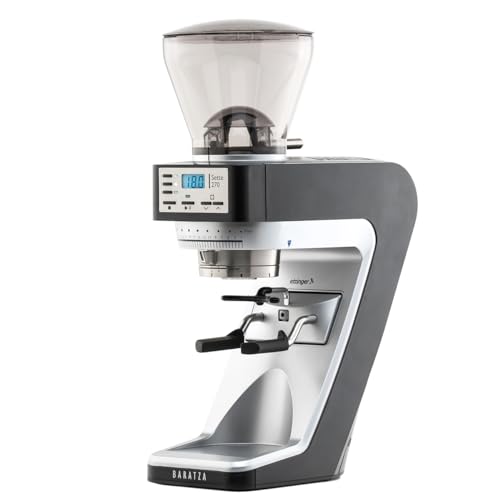
Best for: Home baristas pulling shots daily who want fast, precise dial-in without commercial-grinder bulk. Why it made the list: The Sette’s straight-through grind path drops coffee directly into the portafilter with almost nothing retained, so setting changes show up in the very next shot instead of two shots later. Its stepless micro-adjust ring gives genuinely fine control inside the espresso range, and it grinds faster than nearly anything at its size. Baratza’s repair-friendly support and parts availability are a real long-term advantage.
- Key specs: 40 mm conical steel burrs, stepped macro plus stepless micro adjustment, grinds directly into portafilter, programmable dosing on the 270.
- What we like: Near-zero retention, very fast grinding, true stepless espresso adjustment, and excellent parts support for home repair.
- What we do not like: It is one of the loudest grinders in its class, the gearbox is a known wear item on heavily used units, and it is mediocre for coarse French press grinds.
- Who should buy it: Espresso-first users who tweak their grind often and want changes reflected immediately in the cup.
- Who should avoid it: Anyone grinding mostly for drip or French press, or noise-sensitive households, the Specialita is far quieter.
- Common complaints: Noise, occasional gearbox failures after years of use, and a portafilter cradle that takes adjustment to sit securely.
- Size note: Tall but narrow footprint, check clearance under upper cabinets since beans load from the top hopper.
- Cleaning note: Burrs remove without tools for brushing out, a monthly brush-and-vacuum keeps fines from building up.
- Alternative: The Eureka Mignon Specialita gives quieter, equally refined espresso grinding if you can accept slower output and more retention.
Espresso Grinder Buying Guide
Adjustment resolution is everything
Espresso lives in a tiny band of grind sizes, and the difference between a sour shot and a balanced one can be a single fine step. Stepless grinders or grinders with very small steps let you land exactly on the setting your beans need. Grinders designed for drip have steps too coarse to fine-tune a shot.
Retention and workflow
Retention is the ground coffee trapped inside the grinder between doses. High retention wastes coffee, staleness carries into the next shot, and setting changes lag by a dose or two. Single-dose friendly designs with straight grind paths keep each shot fresh and make dialing in dramatically faster.
Electric versus manual
A quality manual grinder like the JX-Pro matches electric grinders costing much more on grind quality, the tradeoff is about a minute of cranking per shot. If you pull one or two shots a day, manual is the best value in espresso. If you make drinks for a household every morning, buy electric.
Safety Notes
- Unplug the grinder before removing burrs or clearing a jam, never clear a running grinder.
- Keep fingers and utensils out of the burr chamber, feed beans through the hopper only.
- Check beans for stones before grinding, a stone can shatter burrs and send fragments flying.
- Do not grind oily flavored beans in espresso grinders, the residue gums the burrs and motor.
What to Avoid
- Blade grinders, they cannot produce the uniform fine grind espresso requires.
- Entry-level burr grinders that stop short of the espresso range, check the fine end before buying.
- High-retention grinders if you switch beans often, each change wastes a dose or two.
- Any grinder without replacement burrs available, burrs are a consumable over years.
FAQ
Can I use a regular coffee grinder for espresso?
Usually not. Most drip-oriented grinders cannot grind fine enough, and their adjustment steps are too coarse to dial in a shot even when they reach the range. If shots run fast and sour no matter what you do, the grinder is almost always the reason.
Is a manual grinder good enough for espresso?
Yes, a well-built manual grinder like the 1Zpresso JX-Pro produces espresso-grade consistency that embarrasses cheap electric grinders. The cost is effort, roughly a minute of cranking per double shot, which is fine for one or two drinks a day and tiresome beyond that.
How often should espresso burrs be replaced?
Steel burrs typically last several hundred kilograms of coffee, which is many years of home use. Replace them when shots become hard to dial in and taste flat despite fresh beans. Brushing burrs out monthly extends their sharp lifespan.
Final Verdict
The Baratza Sette 270 is the best espresso grinder for home baristas, with the Breville Smart Grinder Pro as the value pick that also covers drip and the 1Zpresso JX-Pro delivering true espresso quality on a budget.
Related Guides
- Best Espresso Machines With a Grinder in 2026
- Best Espresso Machines in 2026: Home Picks for Every Level
- Espresso Machine vs Coffee Maker: What Is the Difference?
- Best Coffee Makers with Grinder in 2026: Grind-and-Brew Picks
- Burr Grinder vs Blade Grinder: Which Is Better for Coffee?
- All Coffee Makers guides
