Updated 18 July 2026 · Specifications and Amazon availability checked 18 July 2026 · Written by MKB Team
A home espresso machine is a bigger commitment than a drip maker, so the right one depends on how hands-on you want to be. Some pull a great shot at the push of a button and froth milk automatically; others reward you for learning and let you dial everything in. We compared five machines across every level, from beginner-friendly to prosumer to fully manual, and matched each to the cook behind the cup. We did not run a pressure-profiling lab, so our recommendations draw on manufacturer specifications and owner feedback.
For most beginners the Breville Bambino Plus is the smart start: fast heat-up, real espresso and automatic milk texturing. Want one machine that grinds too? The Barista Express. Ready to learn the craft? The Gaggia Classic Pro is the classic teacher.
- Best for beginners: Breville Bambino Plus · Check price
- Best all-in-one with grinder: Breville Barista Express · Check price
- Best for learning: Gaggia Classic Pro · Check price
- Best compact budget: De’Longhi Dedica · Check price
- Best manual, no electricity: Flair 49 · Check price
Affiliate Disclosure: As an Amazon Associate we earn from qualifying purchases. This never changes our rankings, and the specifications below come from each manufacturer’s current listing.
Side-by-Side Comparison
| Machine | Level | Milk | Grinder | Best for | Buy |
|---|---|---|---|---|---|
| Bambino Plus | Beginner | Automatic | No | Easy real espresso | Check price |
| Barista Express | Beginner to intermediate | Manual steam wand | Built-in | One-box setup | Check price |
| Gaggia Classic Pro | Intermediate to prosumer | Manual steam wand | No | Learning the craft | Check price |
| De’Longhi Dedica | Beginner budget | Manual frother | No | Small kitchens | Check price |
| Flair 49 | Manual enthusiast | None | No | Off-grid, hands-on | Check price |
How We Evaluated These Picks
We are a research desk, not a coffee lab, so we did not pressure-profile each machine. We compared shot quality and consistency, the milk system and how easy it is to froth, whether a grinder is included, the learning curve, and long-run owner feedback.
Match the Machine to How Hands-On You Want to Be
Home espresso splits by how much you want to do yourself. Automatic-milk machines like the Bambino Plus pull a real shot and texture the milk for you, so you get a good flat white with little practice. Manual steam-wand machines like the Barista Express and Gaggia Classic Pro give you control over the milk and the shot, which means a learning curve but better results as you improve.
The other choices are the grinder and the power. A machine with a built-in grinder, like the Barista Express, is a one-box setup, while separate machines expect you to buy a grinder, which most enthusiasts do anyway for quality. And a manual lever like the Flair needs no electricity at all, pulling espresso by hand, which suits travel, camping and hands-on hobbyists but is the most involved to use.
Best for Beginners: Breville Bambino Plus

Best for: Newcomers who want genuine espresso and easy, automatic milk with almost no learning
Specifications
| Level | Beginner |
| Milk | Automatic texturing |
| Heat-up | Seconds (ThermoJet) |
| Portafilter | 54mm |
| Grinder | No |
| Best for | First machine |
The Breville Bambino Plus is the easiest way into real espresso. Its ThermoJet heating system is ready in seconds, it pulls a proper pressurised or unpressurised shot, and the standout feature is automatic milk texturing: set the temperature and froth level and it steams the milk for you, so a good flat white takes little skill. It is compact and beginner-proof while still using a real 54mm portafilter.
It has no grinder, so you will need to buy one, and enthusiasts will eventually want more manual control. But as a first machine that makes genuinely good coffee, it is hard to beat. Who should skip it: anyone who wants a built-in grinder or full manual control. Pros: fast heat-up, automatic milk, real espresso, compact. Cons: no grinder, limited manual control.
Model reviewed: Breville Bambino Plus Espresso Machine, ASIN B07JVD78TT
Best All-in-One with Grinder: Breville Barista Express

Best for: People who want one box that grinds, doses and pulls without buying a separate grinder
Specifications
| Level | Beginner to intermediate |
| Milk | Manual steam wand |
| Grinder | Built-in conical burr |
| Portafilter | 54mm |
| Dose | Adjustable |
| Best for | All-in-one |
The Barista Express is the popular one-box solution. It has a built-in conical burr grinder that doses straight into the portafilter, so you go from beans to shot on a single machine, with a manual steam wand for latte art and enough control to grow into. Dose and grind settings let you dial in your coffee, and it strikes a strong balance of convenience and craft.
It is larger on the counter, and the built-in grinder, while good, is not as capable as a dedicated one. But for a complete setup in one purchase it is excellent. Who should skip it: anyone tight on space or who already owns a great grinder. Pros: built-in grinder, manual steam wand, room to learn, all-in-one. Cons: large, grinder not top-tier.
Model reviewed: Breville Barista Express Espresso Machine, ASIN B00CH9QWOU
Best for Learning: Gaggia Classic Pro
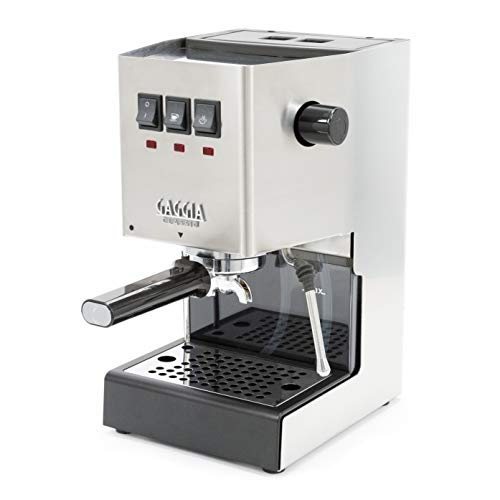
Best for: Enthusiasts who want a rebuildable classic that teaches real espresso skills
Specifications
| Level | Intermediate to prosumer |
| Milk | Manual steam wand |
| Portafilter | 58mm commercial |
| Boiler | Single |
| Build | Rebuildable |
| Best for | Learning |
The Gaggia Classic Pro is the machine that has taught countless people espresso. It uses a commercial-style 58mm portafilter, the same size as cafe machines, a proper steam wand, and a simple single-boiler design that is famously durable and rebuildable, so it can last decades and be upgraded. It rewards learning with genuinely cafe-quality shots.
It has a learning curve, no grinder, and single-boiler means waiting between pulling a shot and steaming milk. But for developing real skills on a machine that lasts, it is the classic choice. Who should skip it: anyone who wants push-button ease. Pros: 58mm commercial portafilter, durable and rebuildable, great steam wand, teaches the craft. Cons: learning curve, no grinder, single boiler.
Model reviewed: Gaggia Classic Pro Espresso Machine, ASIN B07RQ3NL76
Best Compact Budget: De’Longhi Dedica

Best for: Small kitchens and budgets that still want to make espresso and milk drinks
Specifications
| Level | Beginner |
| Milk | Manual frother |
| Width | About 6 inches |
| Pressure | 15 bar |
| Grinder | No |
| Best for | Compact budget |
The De’Longhi Dedica squeezes espresso into a remarkably narrow body, only about six inches wide, making it ideal for tight counters. It heats quickly, pulls a 15-bar shot, and includes a manual frother for cappuccinos and lattes, all at a budget price. For someone who wants to try espresso without much space or money, it delivers.
It leans on pressurised baskets that flatter cheaper coffee rather than rewarding fine technique, and it is less capable than the premium machines. But as a compact, affordable entry it is a lot of machine. Who should skip it: anyone chasing top shot quality or planning to grow serious about espresso. Pros: very compact, affordable, quick heat-up, includes frother. Cons: pressurised baskets, limited ceiling, budget build.
Model reviewed: De’Longhi Dedica Espresso Machine, ASIN B0F3RZZZF9
Best Manual, No Electricity: Flair 49

Best for: Hands-on hobbyists and travelers who want lever espresso anywhere
Specifications
| Level | Manual enthusiast |
| Power | None, lever |
| Milk | None |
| Portable | Yes, carry case |
| Grinder | No |
| Best for | Off-grid |
The Flair 49 makes real espresso entirely by hand, with no electricity at all. You heat water separately, add it to the brew head, and pull the shot with a lever, controlling the pressure yourself. The all-manual design means cafe-quality espresso off-grid, on the road or camping, and it dismantles into a carry case. For enthusiasts who love the process, it is deeply satisfying.
There is no milk steaming, you supply the hot water and grinder, and it is the most involved to use of anything here. But for control, portability and the ritual, nothing else compares. Who should skip it: anyone who wants convenience or automatic milk. Pros: no electricity, full pressure control, portable, real espresso. Cons: no milk steaming, most involved, needs separate kettle and grinder.
Model reviewed: Flair 49 Manual Espresso Maker, ASIN B0842H62PV
Which Espresso Machine Should You Buy?
Best for a first machine
The Breville Bambino Plus, which pulls real espresso and textures milk automatically with almost no learning curve.
Best if you have no grinder
The Barista Express, with a built-in grinder that doses straight into the portafilter for a complete one-box setup.
Best for learning the craft
The Gaggia Classic Pro, a durable, rebuildable classic with a commercial-size portafilter that teaches real skills.
Best for a tiny kitchen
The De’Longhi Dedica, only about six inches wide, with a quick heat-up and a frother, at a budget price.
Best for travel and control
The Flair 49, an all-manual lever maker that needs no power and pulls espresso anywhere.
Buying Guide
Decide how hands-on you want to be
Automatic-milk machines are easiest; manual steam wands and levers reward learning with better results. Be honest about your patience before buying.
Budget for a grinder
Only the Barista Express here includes one. Fresh, consistent grounds matter more than the machine, so factor a grinder into your budget.
Portafilter size hints at the class
A 58mm commercial portafilter, like the Gaggia’s, matches cafe machines and the widest accessory range; smaller ones are fine but more limited.
Pressurised vs unpressurised baskets
Pressurised baskets flatter cheaper coffee and grinders; unpressurised baskets reward good grind and technique. Beginners often start pressurised and move on.
Care and Maintenance
- Purge and wipe the steam wand immediately after every use so milk does not dry inside it.
- Backflush and descale on the maker’s schedule to protect the group and boiler.
- Use filtered water to slow scale, which is the main killer of espresso machines.
- Keep the portafilter and baskets clean so old coffee oils do not taint the shot.
Frequently Asked Questions
Do I need a separate grinder for an espresso machine?
Usually yes. Only all-in-one machines like the Barista Express include a grinder. Fresh, consistent grounds matter enormously for espresso, so budget for a good grinder with any machine that lacks one.
What is the easiest espresso machine for beginners?
The Breville Bambino Plus. It heats in seconds, pulls a real shot, and textures milk automatically, so you can make a good flat white with very little practice.
Is the Gaggia Classic Pro good for beginners?
It is beginner-friendly if you want to learn. It needs a little practice and a grinder, but it uses a commercial-size portafilter and is durable and rebuildable, so it grows with you for years.
Can you make espresso without electricity?
Yes, with a manual lever maker like the Flair 49. You heat water separately and pull the shot by hand, which makes real espresso off-grid or while traveling.
Sources and References
Specifications were checked against each manufacturer’s Amazon listing on 18 July 2026 (Breville, Gaggia, De’Longhi and Flair). Where a maker does not state a figure, we describe the design rather than invent a number.
Final Verdict
For most beginners the Breville Bambino Plus is the smart start: fast, real espresso with automatic milk and almost no learning curve. The Barista Express adds a built-in grinder for a complete one-box setup, the Gaggia Classic Pro is the durable classic for learning the craft, the De’Longhi Dedica squeezes espresso into a tiny, affordable body, and the Flair 49 makes lever espresso anywhere with no power. Decide how hands-on you want to be, budget for a grinder, and pick the machine that matches your patience and your counter.
