The OXO Good Grips Pro 8-Inch Nonstick Fry Pan is the best small pan for eggs, pairing a durable three-layer nonstick coating with a hard-anodized body that heats evenly at the low temperatures eggs need. An 8-inch pan is the right size for one or two eggs or a single omelet, and it keeps folding and sliding effortless. Treat any nonstick pan as a consumable, though, since even the best coatings wear out in a few years.
The OXO Good Grips Pro 8-inch fry pan is the best nonstick egg pan thanks to its durable coating, even heating, and comfortable handle. The Tramontina Professional restaurant pan is the value pick, and a basic T-fal covers tight budgets.
- Best overall: OXO Good Grips Pro 8-Inch Nonstick Fry Pan
- Best value: Tramontina Professional 8-Inch Nonstick Restaurant Fry Pan
- Best budget: T-fal 8-Inch Nonstick Fry Pan with Thermo-Spot
- Avoid: Ultra-thin bargain pans that warp and develop hot spots, which makes eggs stick within months
Affiliate Disclosure: As an Amazon Associate, we earn from qualifying purchases. This does not affect our product rankings or recommendations.
Quick Picks
- Best overall: OXO Good Grips Pro 8-Inch Nonstick Fry Pan, Durable coating and even heat, the complete egg pan. Check price on Amazon
- Best value: Tramontina Professional 8-Inch Nonstick Fry Pan, Restaurant-grade build at a home-kitchen price.
- Best budget: T-fal 8-Inch Nonstick Fry Pan with Thermo-Spot, Cheap, light, and slick, ideal as a replaceable egg pan.
Comparison Table
| Pan | Coating | Best for | Oven safe | Buy |
|---|---|---|---|---|
| OXO Good Grips Pro | 3-layer PTFE, hard-anodized body | Everyday eggs and omelets | Yes, moderate temps | Check Price |
| Tramontina Professional | Reinforced PTFE, aluminum body | Heavy use and durability | Yes, moderate temps | Check Price |
| T-fal with Thermo-Spot | PTFE with heat indicator | Budget and light use | Low temps only | Check Price |
| GreenPan Rio | Ceramic (PTFE-free) | PTFE-free preference | Yes, moderate temps | Check Price |
How We Chose These 8-Inch Nonstick Pan Picks
We compared coating construction, base thickness, handle design, and oven ratings across the most popular 8-inch nonstick pans, then checked long-run owner reviews for how each coating held up after a year or more. Egg release after months of use counted for more than out-of-the-box slickness, since every new nonstick pan starts slippery.
Key Takeaway: For eggs, buy a pan with a thick, flat base and treat it gently: low heat, no metal utensils, no dishwasher. The coating, not the pan, is what you are really buying.
Best Overall: OXO Good Grips Pro 8-Inch Nonstick Fry Pan
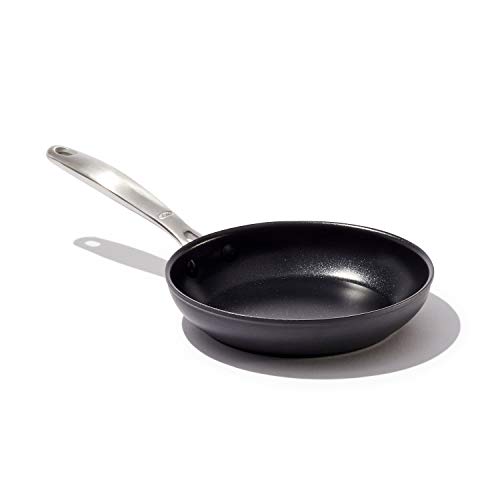
Best for: Anyone who cooks eggs most mornings and wants a small pan whose coating still releases cleanly after a couple of years. Why it made the list: The hard-anodized body spreads low heat evenly so whites set without browning, the three-layer coating is among the more durable in this class, and the rounded low-profile sides make omelet folds and pan slides easy.
- Key specs: 8 inch diameter, hard-anodized aluminum body, three-layer PTFE nonstick, stainless handle insert, oven safe at moderate temperatures.
- What we like: Even heat with no hot spots, a genuinely comfortable grippy handle, and a coating that outlasts most competitors at this size.
- What we do not like: It is not induction compatible, and like every PTFE pan the coating is still a consumable that scratches if you use metal utensils.
- Who should buy it: Daily egg cooks who want the best durability-to-cost ratio in a small nonstick pan.
- Who should avoid it: Induction cooktop owners, and anyone who wants a buy-it-for-life pan, since no nonstick coating lasts forever.
- Common complaints: A minority of owners report the coating losing its slip after a year or two, usually tied to high heat or dishwasher use, and some find the pan heavier than bargain alternatives.
- Size note: 8 inches fits one to two eggs or a two-egg omelet; for scrambles for three or more people, size up to 10 inches.
- Cleaning note: Hand wash with a soft sponge and let it cool before rinsing. Dishwasher detergent dulls nonstick coatings faster than anything else.
- Alternative: The GreenPan Rio is the pick if you specifically want a PTFE-free ceramic coating, accepting a shorter nonstick lifespan.
Egg Pan Buying Guide
Why 8 inches is the egg sweet spot
A small pan concentrates the eggs over the burner so heat stays even edge to edge, and the short sidewalls give a spatula easy access for flips and folds. In a big pan, one or two eggs spread thin and overcook at the edges. Buy the pan to fit the portion, not the stove.
PTFE vs ceramic coatings
Traditional PTFE coatings stay slick longer and release eggs more reliably over their life. Ceramic coatings are PTFE-free and start out impressively slick but typically lose their release faster, often within a year of regular use. Either is safe at normal egg-cooking temperatures; the tradeoff is lifespan versus material preference.
Base thickness and handle comfort
A thicker forged or hard-anodized base resists warping and spreads heat evenly, which matters because a warped pan pools oil and sticks. Look for a handle that stays cool and feels secure with a flick of the wrist, since egg cookery is mostly wrist work. Riveted or solidly welded handles beat screwed-on ones over time.
Safety Notes
- Keep nonstick pans at medium heat or below, since overheating an empty PTFE pan can release fumes and ruins the coating.
- Use silicone, wood, or nylon utensils only, because metal scratches expose the base layer.
- Never run cold water into a hot pan; thermal shock warps thin bases.
- Replace any nonstick pan that is flaking or deeply scratched rather than continuing to cook on it.
What to Avoid
- Ultra-cheap thin pans that warp on the first high-heat mistake and never sit flat again.
- Metal utensils and abrasive scrubbers, the two fastest coating killers.
- Dishwashers, which quietly strip coating performance a little more with every cycle.
- Preheating any nonstick pan empty on high, especially on powerful burners.
FAQ
How long should a nonstick egg pan last?
With gentle use, two to four years is realistic for a quality PTFE pan, and one to two years for most ceramic coatings. Heavy heat, metal tools, and dishwashers shorten that dramatically. When eggs start dragging even with butter, it is time to replace the pan.
Is nonstick cookware safe for daily eggs?
Yes at normal cooking temperatures. Modern PTFE coatings are PFOA-free and stable at the low to medium heat eggs require. The only real risk is badly overheating an empty pan, which is easy to avoid with eggs since they cook gently by nature.
Do I need any oil in a nonstick pan?
A small pat of butter or a teaspoon of oil is still worth using. It improves flavor and browning, and it protects the coating by reducing dry friction. Cooking spray is the one thing to skip, since its lecithin builds a gummy layer that ruins nonstick release.
Final Verdict
The OXO Good Grips Pro 8-Inch Nonstick Fry Pan is the best small egg pan you can buy, with the Tramontina Professional offering restaurant-grade durability for less and the T-fal with Thermo-Spot covering budget kitchens that just need eggs to slide.
Related Guides
- Best Cookware Sets in 2026: Stainless, Nonstick and Cast Iron Compared
- Best Nonstick Cookware in 2026: Easy-Release Picks
- Best Ceramic Cookware in 2026: Non-Toxic Nonstick Picks
- Best Frying Pans in 2026: Searing and Nonstick Picks
- Nonstick vs Stainless Steel Cookware: Which to Use?
- All Cookware guides
