The Hawkins Futura Nonstick Dosa Tawa is the best dosa pan for most home cooks because its thick aluminum base spreads heat evenly across the full surface, which is the single biggest factor in getting a dosa that browns uniformly instead of burning in the center. A dosa tawa is not just a flat pan; it needs low sides for spreading batter, a wide diameter, and either reliable nonstick or well-built seasoning. Here are the four pans that do the job properly, from nonstick convenience to traditional cast iron.
The Hawkins Futura Nonstick Dosa Tawa is the best overall dosa pan thanks to its thick, even-heating base and durable nonstick surface that releases thin batter cleanly. If you want traditional flavor and lifetime durability, the Lodge cast iron griddle is the budget-friendly classic.
- Best overall: Hawkins Futura Nonstick Dosa Tawa
- Best value: Prestige Omega Deluxe Granite Tawa
- Best budget: Lodge 10.5 Inch Cast Iron Griddle
- Avoid: Thin lightweight tawas that develop hot spots and warp
Affiliate Disclosure: As an Amazon Associate, we earn from qualifying purchases. This does not affect our product rankings or recommendations.
Quick Picks
- Best overall: Hawkins Futura Nonstick Dosa Tawa, Thick even-heating base and durable nonstick made specifically for dosa. Check price on Amazon
- Best value: Prestige Omega Deluxe Granite Tawa, Granite-finish nonstick with a wide surface at a very fair price.
- Best budget: Lodge 10.5 Inch Cast Iron Griddle, Traditional cast iron flavor and lifetime durability once seasoned.
Comparison Table
| Tawa | Surface | Best for | Weight | Buy |
|---|---|---|---|---|
| Hawkins Futura Nonstick Dosa Tawa | Nonstick over thick aluminum | Everyday dosa with easy release | Medium | Check Price |
| Prestige Omega Deluxe Granite Tawa | Granite-finish nonstick | Budget-conscious daily use | Light | Check Price |
| Lodge 10.5 Inch Cast Iron Griddle | Seasoned cast iron | Traditional crisp dosa and roti | Heavy | Check Price |
| Cuisinart Chef’s Classic Crepe Pan | Nonstick with low sides | Dosa plus crepes on Western stoves | Light | Check Price |
How We Chose These Dosa Tawa Pan Picks
We compared base thickness, surface material, diameter, and rim height across popular tawas, then checked aggregated owner feedback for the two most common failure points, batter sticking during the spread and uneven browning. Pans made specifically for dosa ranked higher than general griddles unless the griddle matched them on flatness and heat spread.
Key Takeaway: Base thickness matters more than the coating. A thick tawa heats evenly and forgives temperature swings, while a thin one burns the center of the dosa before the edges set, no matter what the surface is made of.
Best Overall: Hawkins Futura Nonstick Dosa Tawa
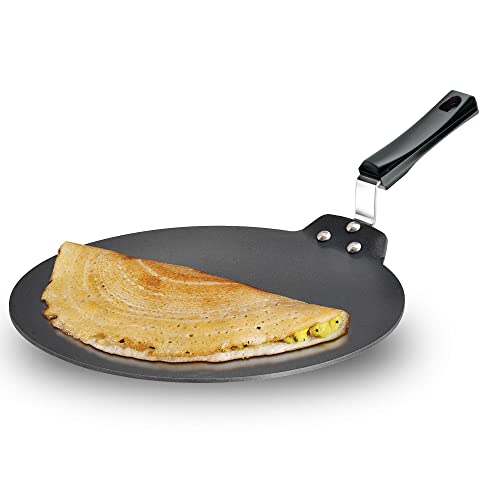
Best for: Home cooks who make dosa regularly and want reliable release and even browning without maintaining cast iron seasoning. Why it made the list: The Futura’s base is noticeably thicker than typical nonstick pans, so heat spreads to the edges before the center overheats, and the hard-wearing nonstick lets you spread thin batter with a ladle without tearing.
- Key specs: Rounded dosa tawa in the Futura hard-anodized line with a thick aluminum base, low profile for spreading batter, and a long stay-cool handle; common sizes are around 10 to 12 inches.
- What we like: Even browning across the whole dosa, easy release with only a few drops of oil, and a surface that also handles uttapam, cheela, and parathas well.
- What we do not like: Most versions are not induction compatible because of the aluminum base, so induction cooks need to confirm they are buying the induction-base variant.
- Who should buy it: Anyone making dosa weekly who wants consistent results with minimal fuss and no seasoning routine.
- Who should avoid it: Cooks on induction stoves who cannot find the induction version, and purists who want the flavor and heat mass of cast iron.
- Common complaints: The nonstick coating eventually wears with metal spatula use, and the pan is slightly heavier than cheap tawas, which surprises some buyers.
- Size note: Pick the largest diameter your burner can heat evenly; a 12 inch tawa on a small burner will brown only in the middle.
- Cleaning note: Hand wash with a soft sponge once cool; deglazing a hot nonstick tawa with cold water shortens coating life.
- Alternative: The Prestige Omega Deluxe Granite Tawa offers a similar experience for less money, with a somewhat less durable coating.
Dosa Tawa Buying Guide
Nonstick vs cast iron
Nonstick tawas are easier for beginners because the batter releases even if your temperature control is off, and cleanup is a wipe. Cast iron gives the classic slightly charred flavor and gets better with years of use, but you must manage seasoning and preheat patiently. If you make dosa once a week or less, nonstick is the practical choice.
Size and rim height
A dosa needs room to spread, so 10 to 12 inches is the useful range, and the rim should be very low or gently sloped so your ladle can sweep to the edge. High-sided pans make the circular spreading motion awkward and produce thick, pale dosas. Also match pan size to your burner, since an oversized tawa on a small flame browns unevenly.
Base thickness and flatness
A thick base holds heat so the pan does not crash in temperature when cold batter hits it, which is what causes sticking mid-batch. Check owner feedback for warping, because a tawa that develops even a slight dome will pool batter at the edges. This is where very cheap pans fail first.
Safety Notes
- Never overheat an empty nonstick tawa; keep it at medium and test with a few drops of water rather than letting it smoke.
- Cast iron handles get dangerously hot, so keep a dry thick towel or silicone sleeve within reach at all times.
- Add oil sparingly with a cut onion or silicone brush rather than pouring, since excess oil on a hot flat pan can spatter.
- Let cast iron cool before rinsing; cold water on a screaming hot pan can crack it and throws steam at your hand.
What to Avoid
- Ultra-light thin tawas, which develop hot spots and warp within months.
- High-sided frying pans marketed as dosa pans, since the rim blocks the spreading motion.
- Nonstick tawas used with metal ladles or spatulas, which destroy the coating quickly.
- Buying a 12 inch tawa for a small apartment burner that can only heat an 8 inch circle.
FAQ
Can I make dosa in a regular nonstick frying pan?
You can, but the raised sides make it hard to spread the batter thin, and most frying pans have a thinner base that browns unevenly. A dedicated tawa or a low-sided crepe pan like the Cuisinart Chef’s Classic gives noticeably better results.
Is cast iron or nonstick better for dosa?
Cast iron gives crispier edges and traditional flavor and lasts a lifetime, but it demands seasoning upkeep and practice with heat control. Nonstick is far more forgiving for beginners and busy weeknights. Many households eventually keep one of each.
Why does my dosa stick to the tawa?
The usual causes are a pan that is too cold when the batter hits it, a worn nonstick coating, or unseasoned cast iron. Preheat until water droplets dance across the surface, rub on a thin film of oil, and keep the heat at medium once you start spreading.
Final Verdict
The Hawkins Futura Nonstick Dosa Tawa is the best dosa pan for most kitchens, with the Prestige Omega Deluxe Granite Tawa delivering similar everyday performance for less and the Lodge 10.5 Inch Cast Iron Griddle serving traditionalists who want crisp edges and a pan that lasts decades.
