UNNI 100% Compostable Bags are the best biodegradable compost bags for most kitchens because they carry both BPI and OK Compost HOME certifications and run thicker than most competitors, so they resist tearing and leaking before collection day. Compost bags live a hard life, holding wet coffee grounds and fruit scraps for days, and the difference between a good bag and a bad one is whether it is still intact when you lift it out of the pail.
UNNI 100% Compostable Bags are the best overall thanks to dual certification and above-average thickness. BioBag is the proven value name, and Primode offers the most bags per box for high-volume households.
- Best overall: UNNI 100% Compostable Bags
- Best value: BioBag Compostable Food Scrap Bags
- Best budget: Primode 100% Compostable Bags
- Avoid: Bags labeled only biodegradable or oxo-degradable with no ASTM D6400 or BPI certification
Affiliate Disclosure: As an Amazon Associate, we earn from qualifying purchases. This does not affect our product rankings or recommendations.
Quick Picks
- Best overall: UNNI 100% Compostable Bags, Dual certified and thicker than most, so wet scraps do not break through.. Check price on Amazon
- Best value: BioBag Compostable Food Scrap Bags, The original compostable bag brand, accepted by nearly every municipal program..
- Best budget: Primode 100% Compostable Bags, Certified bags in large counts for households that fill a pail fast..
Comparison Table
| Bag | Certification | Best for | Common sizes | Buy |
|---|---|---|---|---|
| UNNI 100% Compostable | BPI and OK Compost HOME | Wet scraps held several days | 2.6, 3, and 13 gallon | Check Price |
| BioBag Food Scrap Bags | BPI certified, ASTM D6400 | Municipal curbside programs | 3 gallon | Check Price |
| Primode Compostable | BPI certified, ASTM D6400 | High-volume households | 2.6 and 3 gallon | Check Price |
| Hippo Sak Compostable | BPI certified, ASTM D6400 | Easy carrying with built-in handles | 13 gallon | Check Price |
How We Chose These Biodegradable Compost Bags Picks
We compared certifications, listed thickness, size ranges, and owner feedback across the major compostable bag brands, weighting reports of premature tearing, bottom-seam leaks, and bags degrading in the box before use. Only bags with recognized ASTM D6400 or BPI certification made the list.
Key Takeaway: Certification is the whole game with compost bags. If a bag does not carry BPI, ASTM D6400, or OK Compost certification, many facilities treat it as plastic contamination no matter what the label claims.
Best Overall: UNNI 100% Compostable Bags
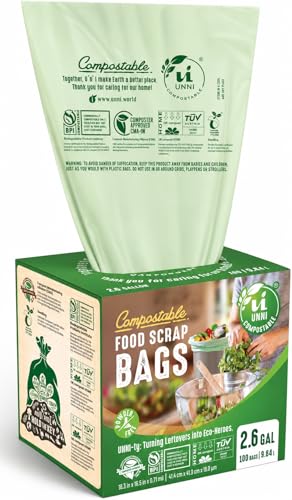
Best for: Households that keep scraps in a countertop pail for several days and need a bag that stays intact until collection. Why it made the list: UNNI bags carry both US BPI certification and the stricter European OK Compost HOME mark, and they measure thicker than most certified competitors, which is exactly what you want when a bag full of wet coffee grounds sits in a pail all week.
- Key specs: BPI certified and OK Compost HOME certified, ASTM D6400 compliant, made from plant starch based material, available in 2.6, 3, and 13 gallon sizes.
- What we like: Thicker feel than typical certified bags, reliable bottom seams, and the HOME certification means they break down even in backyard piles.
- What we do not like: All plant-starch bags have a shelf life, and boxes stored somewhere warm can weaken within a year. They also cost more per bag than plain plastic, which is unavoidable in this category.
- Who should buy it: Anyone whose city requires certified compostable liners, and backyard composters who want bags that actually break down in a home pile.
- Who should avoid it: Anyone who empties scraps daily into an outdoor bin. At that pace a liner is optional and you can simply rinse the pail instead.
- Common complaints: Occasional reports of bags sticking together in the roll, and weakening if very wet scraps sit for more than four or five days.
- Size note: Measure your pail before ordering. The 2.6 gallon fits most standard countertop compost pails, while 3 gallon suits larger caddies.
- Cleaning note: Even with a liner, rinse the pail weekly with vinegar or dish soap to control fruit flies and odor film.
- Alternative: BioBag if your municipality publishes an approved-liner list, since BioBag appears on nearly all of them.
Compost Bag Buying Guide
Certification is non-negotiable
Look for BPI certification or ASTM D6400 compliance in the US, or OK Compost marks from TUV Austria. The word biodegradable alone is meaningless, and oxo-degradable bags are plastic with additives that many facilities ban outright. If your city runs curbside composting, check its approved liner list.
Match thickness to how long scraps sit
Compostable films are weaker than plastic and get weaker as they absorb moisture. If you empty the pail daily, any certified bag works. If scraps sit three to seven days, choose thicker bags like UNNI and keep very wet items, like melon rinds, wrapped in a paper towel.
Buy sizes for your actual pail
A bag that is too small slides down into the pail and gets buried in scraps. Measure your pail volume, then size up slightly so a few inches of bag fold over the rim. Handled bags like Hippo Sak are worth it for larger caddies you carry outside.
Safety Notes
- Store unused bags somewhere cool and dry, heat and humidity start the breakdown process early.
- Keep compost pails and bags away from pets, food scraps can contain items toxic to dogs.
- Do not use compost bags for hot ashes or liquids, they are not built for either.
- Wash hands after handling a full bag, decomposing scraps grow bacteria quickly.
What to Avoid
- Bags labeled biodegradable with no certification logo, most are just plastic.
- Oxo-degradable bags, many compost facilities reject them as contamination.
- Buying more than a year of supply at once, the material weakens in storage.
- Undersized bags that slip into the pail and tear when lifted.
FAQ
What is the difference between biodegradable and compostable bags?
Biodegradable is an unregulated claim that only means the material breaks down eventually, possibly over decades. Compostable bags certified to ASTM D6400 or BPI standards must break down within a set timeframe in composting conditions without leaving toxic residue. Always buy by certification, not the word on the front.
Can I use compostable bags in a backyard compost pile?
Only bags with a HOME certification, like OK Compost HOME, break down reliably in cooler backyard piles. Standard certified bags are designed for industrial facilities that reach higher temperatures, and they can linger in a home pile for a long time.
Why do my compost bags leak before pickup day?
Wet scraps like coffee grounds and fruit accelerate the film breakdown that these bags are designed for. Use a thicker certified bag, empty the pail twice a week, and put a sheet of paper towel at the bottom to absorb excess moisture.
Final Verdict
The UNNI 100% Compostable Bags are the best biodegradable compost bags with their dual certification and above-average thickness, with BioBag as the safest choice for municipal programs and Primode delivering certified bags in bulk counts for busy kitchens.
