The GRAYL GeoPress Water Purifier is the best camping water purifier because it is one of the few portable options that removes viruses in addition to bacteria and protozoa, and it turns a full bottle of questionable water into drinkable water in under a minute with one press. Filters like the Sawyer Squeeze are lighter and cover bacteria and protozoa, which is enough for most North American backcountry, but a true purifier buys you a wider safety margin.
The GRAYL GeoPress is the best all-around choice because it purifies against viruses, bacteria, and protozoa with a simple press, no pumping or waiting. If you only face typical North American streams and want minimal weight, the Sawyer Squeeze is the proven value pick.
- Best overall: GRAYL GeoPress Water Purifier
- Best value: Sawyer Squeeze Water Filter System
- Best budget: LifeStraw Personal Water Filter
- Avoid: Unbranded filter straws with no verified micron rating or test data
Affiliate Disclosure: As an Amazon Associate, we earn from qualifying purchases. This does not affect our product rankings or recommendations.
Quick Picks
- Best overall: GRAYL GeoPress Water Purifier, Removes viruses too, purifies a full bottle in one press. Check price on Amazon
- Best value: Sawyer Squeeze Water Filter System, Featherweight hollow-fiber filter with a massive service life.
- Best budget: LifeStraw Personal Water Filter, Dead-simple emergency straw for day hikes and go-bags.
Comparison Table
| Purifier or filter | Removes viruses | Best for | Weight class | Buy |
|---|---|---|---|---|
| GRAYL GeoPress | Yes | International travel, maximum safety | Heavier, bottle-style | Check Price |
| Sawyer Squeeze | No | Backpacking in North America | Very light | Check Price |
| LifeStraw Personal | No | Emergencies and day hikes | Ultralight | Check Price |
| Katadyn BeFree 1.0L | No | Fast-and-light hikers | Very light | Check Price |
How We Chose These Camping Water Purifier Picks
We compared micron ratings, independent testing claims, flow rates, service life, and field maintenance needs across the leading portable purifiers and filters, then weighed aggregated feedback from backpackers and travelers on clogging, freezing damage, and long-term reliability. We prioritized proven brands whose lab claims have held up over years of real-world use.
Key Takeaway: Match the tool to the threat. Bacteria and protozoa are the main risk in North American backcountry, but if viruses are a possibility, and they are in much of the world, only a purifier like the GeoPress or chemical treatment covers you.
Best Overall: GRAYL GeoPress Water Purifier
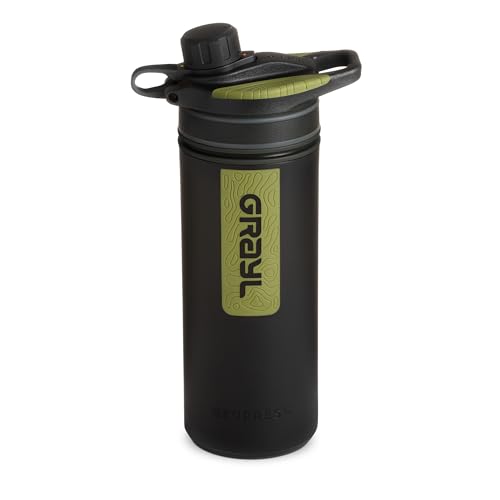
Best for: Campers and travelers who want one tool that handles any water source, including places where viruses are a real concern. Why it made the list: The GeoPress is the simplest full purifier on the market, you fill the outer bottle, press the inner bottle down like a giant french press, and about eight seconds later you have roughly 24 ounces of water treated against viruses, bacteria, protozoa, plus reduced chemicals and sediment.
- Key specs: Press-style purifier, roughly 24 ounce capacity per press, treats viruses, bacteria, and protozoa, activated carbon layer improves taste, replaceable cartridge rated for hundreds of presses.
- What we like: No pumping, no waiting for chemicals, no batteries. The press action is fast and intuitive, and the carbon layer noticeably improves the taste of murky or tannic water.
- What we do not like: It is heavy and bulky compared to a hollow-fiber filter, pressing gets stiff as the cartridge ages, and replacement cartridges are an ongoing expense you have to plan for.
- Who should buy it: International travelers, paddlers on busy waterways, and anyone camping near agricultural runoff or heavy human activity where viruses are plausible.
- Who should avoid it: Gram-counting thru-hikers on well-mapped North American trails, a Sawyer Squeeze covers that use case at a fraction of the weight.
- Common complaints: Owners note the press becomes harder near the end of cartridge life and that the bottle is heavy for backpacking. Both are inherent to the press-purifier design.
- Size note: It takes the space of a large water bottle in a pack side pocket. Count the cartridge spare in your packing plan for long trips.
- Cleaning note: Rinse and air dry fully between trips, and never let a wet cartridge freeze, ice destroys the purification media from the inside.
- Alternative: The Sawyer Squeeze plus chemical tablets as a backup gives you similar coverage at far less weight, with more fiddling.
Camping Water Purifier Buying Guide
Filter vs purifier
A filter physically strains out bacteria and protozoa like giardia and cryptosporidium, which covers most lakes and streams in the US and Canada. A purifier also handles viruses, which matter in developing regions, on heavily used rivers, and anywhere human waste can reach the water. If you are unsure what you will face, buy the purifier.
Flow rate and group size
A straw or squeeze filter is fine for one hiker, but filtering for a family camp becomes tedious fast. For groups, look at gravity systems or a press purifier with real per-batch volume like the GeoPress. Fast-flow filters like the Katadyn BeFree shine for solo hikers who drink as they move.
Maintenance in the field
Hollow-fiber filters need regular backflushing to keep flow up, and every filter slows down in silty water, so pre-filter through a bandana or let sediment settle first. The single most important rule, never let a wetted filter freeze. Ice ruptures the fibers invisibly and the filter stops protecting you without any outward sign.
Safety Notes
- Never let a filter or purifier cartridge freeze after first use, freezing ruptures the media and silently destroys protection.
- Keep the clean-water and dirty-water sides of your system separate, including caps and hoses, to avoid cross-contamination.
- Pre-filter silty or muddy water through cloth first, sediment shortens cartridge life and can force contaminated bypass in worn filters.
- Carry chemical purification tablets as a backup, hardware can clog, crack, or get lost mid-trip.
What to Avoid
- No-name filter straws with unverifiable claims, your stomach is the test lab for their quality control.
- Relying on a bacteria-only filter for international travel where viruses are a real risk.
- Storing a filter wet in a sealed bag between trips, it grows mold in the fibers.
- Ignoring flow-rate decline, a filter that has slowed dramatically is telling you the media is at end of life.
FAQ
Do I really need virus protection for camping in the US?
Usually not, viruses are rare in remote North American backcountry water, which is why filters like the Sawyer Squeeze are the default for thru-hikers. The calculation changes near agriculture, downstream of towns, on busy paddling rivers, and everywhere abroad with questionable sanitation.
How long does a camping water filter last?
Hollow-fiber filters like the Sawyer Squeeze are rated for enormous volumes if maintained, often effectively the life of the product, while press purifier cartridges like GRAYL are rated in hundreds of uses. Freezing, silty water, and skipped backflushing shorten every rating dramatically.
Is boiling better than filtering?
Boiling kills viruses, bacteria, and protozoa reliably, so it is the gold standard when fuel and time allow. It does not remove sediment or improve taste, and it is slow for volume, which is why most campers boil in camp and filter on the move.
Final Verdict
The GRAYL GeoPress is the best camping water purifier because it covers viruses as well as bacteria and protozoa with one fast press, with the Sawyer Squeeze as the proven lightweight value for North American trails and the LifeStraw Personal as the budget insurance policy for day packs and emergency kits.
