
The best bread knife for most people is the Victorinox 10.25-inch serrated, which slices crusty loaves, soft bread and tomatoes cleanly for very little money. A bread knife has a long serrated blade that saws through crust without crushing the crumb. The right one depends on blade length and whether you want pointed or offset serrations. This guide compares four bread knives and how to choose one that cuts cleanly for years.
The Victorinox 10.25-inch serrated is the best bread knife for most people: cuts crusty and soft bread cleanly and is very cheap. Choose an offset bread knife if you want knuckle clearance, or a Mercer for a budget alternative.
- Best overall: Victorinox 10.25-inch Serrated
- Best offset: Dexter-Russell Offset
- Best budget: Mercer Millennia Bread Knife
- Avoid: short serrated knives that struggle with big loaves
Affiliate Disclosure: As an Amazon Associate, we earn from qualifying purchases. This does not affect our product rankings or recommendations.
Quick Picks
- Best overall: Victorinox 10.25-inch Serrated — clean cuts, great value. Check price on Amazon
- Best offset: Dexter-Russell Offset — knuckle clearance for big loaves.
- Best budget: Mercer Millennia — sharp serrations for less.
Comparison Table
| Bread knife | Length | Best for | Serration | Buy |
|---|---|---|---|---|
| Victorinox 10.25″ | 10.25 in | All-round value | Pointed | Check Price |
| Dexter-Russell Offset | ~9 in | Knuckle clearance | Offset | Check Price |
| Mercer Millennia | ~10 in | Budget | Wavy | Check Price |
| Wusthof Classic | ~9 in | Premium forged | Pointed | Check Price |
How We Chose These Bread Knives
We compared bread knives by clean cutting through crust and soft crumb, serration quality, blade length, handle comfort and value. We researched and spec-checked each knife and reviewed owner and professional feedback rather than claiming an in-house product trial. Short knives that crush large loaves were downgraded.
Key Takeaway: A long blade does most of the work. A 10-inch serrated knife slices a big loaf in one or two strokes without sawing, while a short knife tears and crushes. Length and good serrations matter more than price here.
Best Overall: Victorinox 10.25-inch Serrated
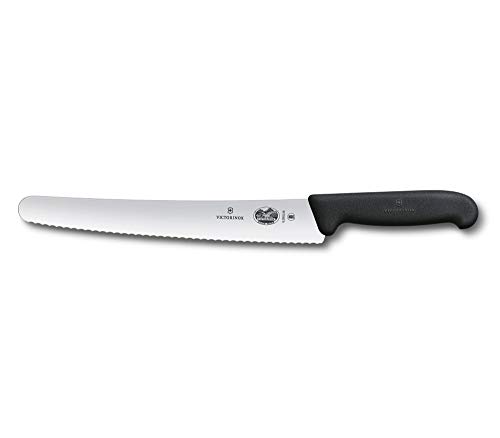
Best for: slicing crusty loaves, soft bread, cakes and tomatoes. Why it made the list: long, sharp serrations that cut cleanly, at a very low price.
- Key specs: 10.25-inch serrated stainless blade, non-slip handle, light.
- What we like: clean cuts, long reach, comfortable, very affordable.
- What we do not like: serrated edges are hard to resharpen at home; plain looks.
- Who should buy it: anyone wanting a great bread knife cheaply.
- Who should avoid it: those wanting an offset blade for knuckle clearance.
- Common complaints: serrations dull eventually and need professional sharpening.
- Size note: a 10-inch blade suits most loaves.
- Cleaning note: hand-wash and dry; never the dishwasher.
- Alternative: Dexter offset for clearance, Mercer for budget.
Bread Knife Buying Guide
Blade Length
A 9 to 10-inch blade slices most loaves in one stroke. Shorter knives crush large loaves.
Offset Handle
An offset bread knife raises your knuckles above the board, useful for slicing flat against a cutting board.
Sharpening Serrated Edges
Serrated edges stay sharp a long time but need special sharpening or professional service. See how to sharpen a knife.
Safety Notes
- Let the serrations do the sawing; do not force it.
- Keep fingers clear of the long blade.
- Cut on a board, not in your hand.
- Hand-wash carefully.
What to Avoid
- Short serrated knives that struggle with big loaves.
- The dishwasher.
- Forcing the blade through crust.
- Trying to grind serrations on a normal sharpener.
FAQ
What is the best bread knife?
The Victorinox 10.25-inch serrated is the best bread knife for most people: it cuts crusty and soft bread cleanly and is very cheap. The Dexter-Russell offset is best for knuckle clearance.
What length bread knife is best?
A 9 to 10-inch blade slices most loaves in one stroke. Shorter blades crush large loaves, so longer is generally better.
Can you sharpen a bread knife?
Serrated bread knives need special sharpening tools or professional service; they cannot be sharpened on a normal stone or pull-through sharpener.
Final Verdict
The Victorinox 10.25-inch serrated is the best bread knife for most people, with the Dexter-Russell offset for knuckle clearance and the Mercer Millennia for budget. A long, sharp serrated blade cuts cleanly for years. See our best knife sets and best chef knives guides.
