The ZeroWater 10-Cup Ready-Pour Pitcher is the best water filter pitcher for hard water because its five-stage ion exchange system actually removes dissolved calcium and magnesium, the minerals that define hardness, and it ships with a TDS meter so you can verify the result yourself. Most pitchers only improve taste and chlorine and leave hardness untouched. The tradeoff is real: hard water exhausts ZeroWater filters quickly, so we also cover longer-lived options and explain when a pitcher is the wrong tool entirely.
The ZeroWater 10-Cup Ready-Pour Pitcher is the only mainstream pitcher that meaningfully reduces hardness minerals, verified by its included TDS meter. If you mainly want better taste rather than mineral removal, the Waterdrop Chubby gives faster flow and longer filter life.
- Best overall: ZeroWater 10-Cup Ready-Pour Pitcher
- Best value: Waterdrop Chubby 10-Cup Pitcher
- Best budget: Brita Everyday Pitcher
- Avoid: Any pitcher marketed as a water softener replacement, none of them are
Affiliate Disclosure: As an Amazon Associate, we earn from qualifying purchases. This does not affect our product rankings or recommendations.
Quick Picks
- Best overall: ZeroWater 10-Cup Ready-Pour Pitcher, Ion exchange removes dissolved hardness minerals, and the included TDS meter proves it.. Check price on Amazon
- Best value: Waterdrop Chubby 10-Cup Pitcher, Fast flow and long filter life for taste and chlorine, though it will not soften water..
- Best budget: Brita Everyday Pitcher, The cheap, reliable standard for taste improvement with widely available filters..
Comparison Table
| Pitcher | Filter approach | Best for | Capacity | Buy |
|---|---|---|---|---|
| ZeroWater Ready-Pour | Five-stage ion exchange | Actually reducing hardness minerals | 10 cups | Check Price |
| Waterdrop Chubby | Carbon block, fast flow | Taste and chlorine with long filter life | 10 cups | Check Price |
| Brita Everyday | Carbon and ion exchange resin | Basic taste upgrade on a budget | 10 cups | Check Price |
| Epic Pure | Dense carbon block | Broad contaminant reduction claims | 10 cups | Check Price |
How We Chose These Water Filter Pitcher Picks
We compared manufacturer filtration claims against what each technology can physically remove, since hardness is dissolved mineral content that ordinary carbon filters pass straight through. We then weighed aggregated owner feedback from hard water regions on filter lifespan, flow rate, and taste at end of filter life.
Key Takeaway: Only ion exchange meaningfully reduces hardness in a pitcher, and the harder your water, the faster those filters exhaust. Test your tap water first, because with very hard water the ongoing filter cost can exceed what a small under-sink system would run you.
Best Overall: ZeroWater 10-Cup Ready-Pour Pitcher
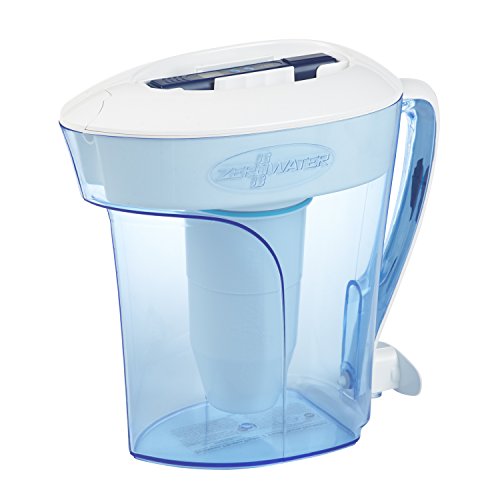
Best for: Households with moderately hard water who want visibly cleaner-tasting water and scale-free kettles, and who are willing to swap filters on schedule. Why it made the list: It is the one pitcher in this class whose chemistry targets dissolved minerals rather than just chlorine and taste, and the bundled meter removes all guesswork about when to change the filter.
- Key specs: Five-stage filter with ion exchange resin and activated carbon, 10-cup reservoir, Ready-Pour spout that lets you pour before filtering finishes, included handheld TDS meter, and a filter change indicator based on meter readings.
- What we like: You can measure dissolved solids before and after and watch the number drop to near zero. Kettles and coffee makers stop scaling, and tea tastes noticeably cleaner in hard water areas.
- What we do not like: Hard water chews through filters fast, sometimes in two to three weeks, and an exhausted filter can give the water a sour, fishy taste almost overnight. Flow is slower than carbon-only pitchers.
- Who should buy it: People with measured hardness who mainly filter drinking and coffee water, a few liters a day, and will replace filters promptly when the meter climbs.
- Who should avoid it: High-volume households with very hard water, the replacement filter cost adds up quickly and an under-sink or reverse osmosis system becomes the smarter path.
- Common complaints: Short filter life in hard water regions is the dominant complaint, followed by the off taste that appears when a filter is pushed past exhaustion.
- Size note: The 10-cup body fits most fridge shelves but is tall, measure your door shelf first. Larger dispenser versions exist in the same filter family if you drink more.
- Cleaning note: Wash the reservoir and lid weekly with warm soapy water and never run the filter under hot water. Check the meter weekly, replace the filter as soon as readings rise.
- Alternative: The Epic Pure pitcher is the pick if your priority is broad contaminant reduction with longer filter intervals, accepting that hardness minerals mostly remain.
Water Filter Pitcher Buying Guide
Know what hard water actually is
Hardness is dissolved calcium and magnesium, and it is not a health hazard, it is a taste, scale, and appliance issue. Standard carbon filters improve chlorine and odor but do not capture dissolved minerals. Only ion exchange resin, the technology ZeroWater uses throughout its filter, meaningfully lowers hardness in a pitcher format.
Filter life claims assume soft water
Manufacturers rate filter life at moderate mineral levels. If your water is very hard, an ion exchange filter can exhaust in a fraction of its rated gallons because the resin sites fill with calcium quickly. Budget for real-world replacement frequency, not the number on the box, and use a TDS meter to verify.
Match the tool to the volume
A pitcher makes sense for drinking water and coffee, a few liters a day. If you want soft water at every tap or your filters are dying in two weeks, a proper under-sink filter or whole-house softener is cheaper per liter within the first year. Be honest about your volume before committing.
Safety Notes
- Replace ion exchange filters promptly, exhausted resin can make water taste sour or fishy.
- Wash the pitcher body weekly, filters remove chlorine, which lets biofilm grow faster in the reservoir.
- Never filter hot water through a pitcher, heat damages the media and can release trapped material.
- Flush new filters per the manual before drinking to clear loose carbon fines.
What to Avoid
- Any pitcher claiming to be a whole-home softener replacement.
- No-name filters with generic contaminant claims and no test data.
- Buying based on rated gallons alone if your water is very hard.
- Leaving a filter installed for months past its indicator, taste and safety both degrade.
FAQ
Do water filter pitchers actually soften hard water?
Only ion exchange pitchers like ZeroWater meaningfully reduce hardness minerals, and they do it by capturing calcium and magnesium in resin that eventually fills up. Carbon-only pitchers such as most Brita and Waterdrop filters improve taste and chlorine but leave hardness essentially unchanged.
Why does my ZeroWater filter die so fast?
Filter life is inversely tied to your total dissolved solids. Very hard water can exhaust a filter in two to three weeks of normal use because the resin saturates quickly. Check the included meter weekly and replace when readings start climbing rather than waiting for bad taste.
Will a filter pitcher stop scale in my kettle?
A true ion exchange pitcher will largely stop new scale because it removes the minerals that form it. A carbon-only pitcher will not, since dissolved calcium passes through. If kettle scale is your main complaint, that distinction should drive your purchase.
Final Verdict
The ZeroWater 10-Cup Ready-Pour Pitcher is the best pitcher for hard water because it genuinely removes hardness minerals, with the Waterdrop Chubby offering faster flow and longer life for taste-focused users and the Brita Everyday covering budget basics.
