The Bosch Universal Plus is the best stand mixer for pizza dough because its 800 watt belt-driven motor and center-post dough hook knead stiff, low-hydration dough for multiple pizzas without straining, walking across the counter, or overheating. Pizza dough is the hardest routine job you can give a mixer, and plenty of popular machines that whip cream beautifully will grind and stall on a double batch at 60 percent hydration. These four handle it, each at a different price and batch size.
The Bosch Universal Plus is the best stand mixer for pizza dough thanks to its powerful belt drive and dough-first design that kneads big, stiff batches without overheating. The Cuisinart SM-50 is the best value for one or two pizzas at a time.
- Best overall: Bosch Universal Plus Stand Mixer
- Best value: Cuisinart SM-50 Stand Mixer
- Best budget: Hamilton Beach 7 Speed Stand Mixer
- Avoid: Low-wattage tilt-head mixers for double batches of stiff dough, which overheat and strain the gears
Affiliate Disclosure: As an Amazon Associate, we earn from qualifying purchases. This does not affect our product rankings or recommendations.
Quick Picks
- Best overall: Bosch Universal Plus Stand Mixer, Kneads multiple stiff dough balls at once without heat or wobble.. Check price on Amazon
- Best value: Cuisinart SM-50 Stand Mixer, 500 watts and a solid dough hook for one or two pizzas at a time..
- Best budget: Hamilton Beach 7 Speed Stand Mixer, Fine for a single small dough ball if you knead in short sessions..
Comparison Table
| Stand mixer | Power | Best for | Dough capacity | Buy |
|---|---|---|---|---|
| Bosch Universal Plus Stand Mixer | 800 watts, belt drive | Frequent bakers, big batches | Dough for 6 or more pizzas | Check Price |
| Cuisinart SM-50 Stand Mixer | 500 watts | Weekly pizza nights | Dough for 2 to 3 pizzas | Check Price |
| Hamilton Beach 7 Speed Stand Mixer | 300 watts | Occasional single batches | 1 small dough ball | Check Price |
| KitchenAid Professional 600 Series | 575 watts, bowl-lift | KitchenAid loyalists with attachments | Dough for 3 to 4 pizzas | Check Price |
How We Chose These Stand Mixer Picks
We compared motor design, wattage, kneading action, and bowl geometry, then focused owner research on the failure mode that matters here: how each machine behaves with stiff, low-hydration pizza and bagel dough. Mixers earned their spot by kneading without overheating, stalling, or dancing across the counter.
Key Takeaway: For pizza dough, motor design beats raw wattage claims. Belt-driven and bowl-lift machines built for bread survive years of stiff dough, while entry tilt-head mixers should be limited to single, softer batches.
Best Overall: Bosch Universal Plus Stand Mixer
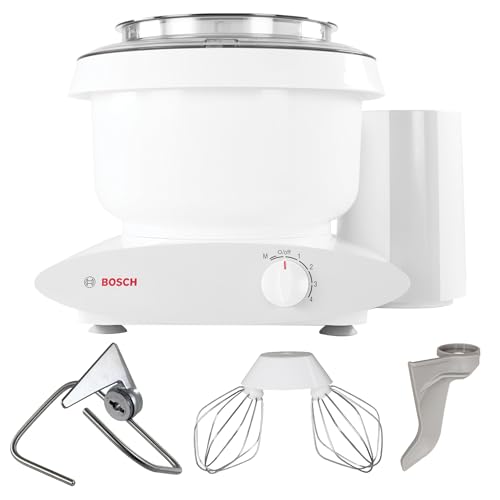
Best for: Households that make pizza weekly or bake bread regularly and want a mixer that treats stiff dough as its main job rather than its stress test. Why it made the list: The motor sits under the bowl driving a center-post dough hook through a belt transmission, a layout that delivers steady torque to heavy dough without the gear strain that plagues traditional designs. It kneads enough dough for six or more pizzas in one session, stays cool doing it, and the suction feet keep it planted. Owners routinely report these machines lasting decades on heavy bread duty.
- Key specs: 800 watt belt-driven motor, 6.5 quart bowl, center-column dough hook, suction feet, and a design that handles up to roughly 14 cups of flour.
- What we like: Effortless with stiff, low-hydration dough, no counter walking, big single-session capacity, and a motor that never smells hot.
- What we do not like: The center post makes scraping and small batches awkward, whipping and creaming need accessory attachments to shine, and the plastic bowl feels less premium than metal.
- Who should buy it: Serious pizza and bread bakers, big families, and anyone doubling recipes who has already burned out a lesser mixer.
- Who should avoid it: Bakers who mostly cream butter and whip frosting and only make occasional dough; a KitchenAid-style planetary mixer is more versatile for cakes.
- Common complaints: A minority of owners dislike that very small single-pizza batches do not engage the hook well, so it rewards making dough in bulk and freezing extras.
- Size note: It is wider than a tilt-head mixer but shorter, so it fits under most upper cabinets where bowl-lift machines will not.
- Cleaning note: The bowl and hook are simple to wash, but flour dust collects around the drive column, so wipe it after each session.
- Alternative: The KitchenAid Professional 600 Series is the pick if you are invested in KitchenAid hub attachments like pasta rollers.
Stand Mixer for Pizza Dough Buying Guide
Why pizza dough is the hard case
Pizza dough is typically 55 to 65 percent hydration, far stiffer than sandwich bread or cookie dough, and it fights the mixer for eight to ten minutes of kneading. That sustained load is what overheats small motors and wears plastic gears. If a mixer’s manual caps dough at speed 2 for a reason, believe it and respect batch limits.
Motor and drive design
Belt-driven and DC-motor machines transfer power smoothly and shrug off stalls, while cheap gear-driven motors transmit every shock straight into the gearbox. Wattage numbers across brands are not comparable, so look instead for flour capacity ratings and a dough hook that reaches the bowl wall. Bowl-lift designs are generally sturdier under stiff dough than tilt-head designs.
Capacity and batch planning
Match the machine to your real batch: one or two pizzas a week is fine on a 5 quart mixer, while doubling for a crowd needs a 6 quart bowl-lift or a Bosch-style machine. Underloading a giant mixer is nearly as bad as overloading a small one, because the hook cannot engage a tiny dough ball. Making a large batch and cold-fermenting portions in the fridge is the most mixer-friendly workflow.
Safety Notes
- Never exceed the flour capacity in your mixer’s manual; stiff dough overloads motors faster than any other job.
- Keep fingers and spatulas out of the bowl while the hook is turning, and stop the machine to scrape.
- If the motor housing gets hot or smells electrical, stop and let it cool before finishing the knead by hand.
- Lock the head or bowl properly before starting, since stiff dough can bounce an unlatched head.
What to Avoid
- Mixers under about 300 watts for any regular dough work.
- Doubling dough recipes in a 4.5 or 5 quart tilt-head machine.
- Running stiff dough above the manufacturer’s recommended kneading speed, which burns motors.
- Plastic-geared bargain mixers whose gearboxes strip within months of dough duty.
FAQ
Can a KitchenAid handle pizza dough?
Yes, within limits: a single batch at speed 2 is fine on an Artisan, and the Professional 600 handles three to four dough balls. The machines struggle when people double batches or knead stiff dough at higher speeds, which is where the gear and overheating complaints come from.
How long should I knead pizza dough in a stand mixer?
Typically 8 to 10 minutes on low speed until the dough is smooth and passes the windowpane test. If your mixer labors or heats up before then, rest the dough for 10 minutes and finish with a few minutes of hand kneading.
Is a food processor better than a stand mixer for pizza dough?
A food processor kneads a single batch impressively fast, often under two minutes, but capacity is limited and the friction warms the dough. A stand mixer is better for bigger batches and gentler development, which most home pizza makers prefer.
Final Verdict
The Bosch Universal Plus is the best stand mixer for pizza dough, with the Cuisinart SM-50 as the value pick for weekly pizza nights and the KitchenAid Professional 600 Series as the choice for bakers already invested in KitchenAid attachments.
