
The best saucepan set for most people is a tri-ply stainless set like the Cuisinart Multiclad Pro, which usually includes 1.5 to 4 quart pans with lids for sauces, grains, boiling and reheating. A good saucepan has even heat, a comfortable handle and a well-fitting lid. The right set depends on your household size and cooktop. This guide compares four saucepan options and explains the sizes you actually need.
For most kitchens, a tri-ply stainless saucepan set like the Cuisinart Multiclad Pro is best: even heat, durable and oven-safe. A 2-quart and a 3 to 4-quart saucepan cover most cooking. Add nonstick if you often cook sticky sauces.
- Best overall: Cuisinart Multiclad Pro saucepans
- Best premium: All-Clad D3 saucepans
- Best value: Tramontina Tri-Ply saucepans
- Avoid: thin pans that scorch sauces and milk
Affiliate Disclosure: As an Amazon Associate, we earn from qualifying purchases. This does not affect our product rankings or recommendations.
Quick Picks
- Best overall: Cuisinart Multiclad Pro — even heat, durable, well-priced. Check price on Amazon
- Best premium: All-Clad D3 — lifelong, even, precise.
- Best value: Tramontina Tri-Ply — near-premium for less.
Comparison Table
| Saucepan set | Material | Typical sizes | Induction | Buy |
|---|---|---|---|---|
| Cuisinart Multiclad Pro | Tri-ply stainless | 1.5, 3 qt + lids | Yes | Check Price |
| All-Clad D3 | Tri-ply stainless | 2, 4 qt + lids | Yes | Check Price |
| Tramontina Tri-Ply | Tri-ply stainless | 1.5, 3 qt + lids | Yes | Check Price |
| T-fal nonstick | Nonstick | 1, 2, 3 qt + lids | Some models | Check Price |
How We Chose These Saucepan Sets
We compared saucepan sets by heat evenness, lid fit, handle comfort, durability, oven-safety, cooktop compatibility, useful sizes and value. We researched and spec-checked each option and reviewed owner feedback rather than claiming an in-house product trial. Thin pans prone to scorching were downgraded.
Key Takeaway: Even heat matters most for saucepans because they handle milk, sauces and custards that scorch in thin pans. Tri-ply construction is what stops the bottom burning while the rest catches up.
Best Overall: Cuisinart Multiclad Pro Saucepans
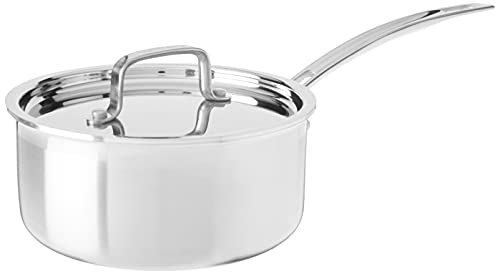
Best for: sauces, grains, boiling and reheating in a durable, even-heating set. Why it made the list: tri-ply construction, even heat and oven-safety at a fair price.
- Key specs: tri-ply stainless with aluminium core, oven-safe to around 500F, induction-ready, well-fitting lids.
- What we like: even heat, no scorching, durable, no coating to wear.
- What we do not like: sticky sauces need stirring; not nonstick.
- Who should buy it: anyone wanting lifelong, even-heating saucepans.
- Who should avoid it: those who only want nonstick for sticky sauces.
- Common complaints: sticking with milk-based sauces if unstirred.
- Size note: a 2-quart and a 3 to 4-quart cover most cooking.
- Cleaning note: soak and use Bar Keepers Friend for scorch marks.
- Alternative: All-Clad for premium, T-fal nonstick for sticky sauces.
Saucepan Buying Guide
Sizes You Need
A 2-quart saucepan handles sauces and reheating; a 3 to 4-quart handles grains, pasta and soups. Two sizes cover most kitchens. See what cookware you actually need.
Material
Tri-ply stainless heats evenly and lasts; nonstick suits sticky sauces but wears out. See nonstick vs stainless steel.
Lids and Handles
Look for well-fitting lids that trap heat and stay-cool or comfortable handles for pouring.
Safety Notes
- Handles get hot in the oven; use mitts.
- Stir milk and sauces to prevent scorching.
- Do not overheat nonstick saucepans.
- Check the oven-safe temperature for lids and pans.
What to Avoid
- Thin pans that scorch sauces and milk.
- Sets padded with sizes you will not use.
- Non-induction pans if you have induction.
- Metal utensils on nonstick saucepans.
FAQ
What is the best saucepan set?
A tri-ply stainless set like the Cuisinart Multiclad Pro is the best saucepan set for most people, with even heat and durability. All-Clad D3 is the premium pick.
What size saucepan do I need?
A 2-quart saucepan for sauces and reheating and a 3 to 4-quart for grains, pasta and soups cover most kitchens.
Are stainless or nonstick saucepans better?
Stainless is more durable and even-heating for most cooking; nonstick is handy for sticky sauces but wears out. Many cooks own mostly stainless plus one nonstick.
Final Verdict
The Cuisinart Multiclad Pro saucepans are the best for most people, with All-Clad D3 premium and Tramontina Tri-Ply the value pick. A 2-quart and a 3 to 4-quart cover most cooking. See our best cookware sets guide.
Related Guides
- Best 3 Quart Saucepan in 2026: Tri-Ply Clad for Even Heating and Durability
- Best Sixteen Quart Stockpot for Stock in 2026: Heavy-Duty, Even Heating
- Best Griddle Pan for Stovetop in 2026: Even Heating and Nonstick Performance
- Best Cookware Sets in 2026: Stainless, Nonstick and Cast Iron Compared
- Best Budget Cookware Sets in 2026: Value Picks
- All Cookware guides
