The best reverse osmosis system for home use is the APEC Water Systems ROES-50, a proven 5-stage under-sink filter that strips out up to 99% of contaminants while keeping a decent flow rate and easy filter changes. We analyzed specs and thousands of owner reviews to find systems that balance filtration performance, installation difficulty, long-term cost, and water waste. Here are our top picks.
For most households, the APEC ROES-50 is the best overall due to its reliable 5-stage filtration, low maintenance, and good value. If you want faster flow and a tankless design, the Waterdrop G3P800 is the best value. For a tight budget, the Express Water 5-stage delivers solid performance. Avoid systems with plastic housings that crack or leak, like some generic brands.
- Best overall: APEC ROES-50
- Best value: Waterdrop G3P800
- Best budget: Express Water 5-stage
- Avoid: Generic unbranded RO systems with plastic fittings
Affiliate Disclosure: As an Amazon Associate, we earn from qualifying purchases. This does not affect our product rankings or recommendations.
Quick Picks
- Best overall: APEC ROES-50, Reliable 5-stage filtration with easy DIY installation and long-lasting filters.. Check price on Amazon
- Best value: Waterdrop G3P800, Tankless design with high flow rate and smart faucet, but higher filter cost.. Check price on Amazon
- Best budget: Express Water 5-stage, Affordable 5-stage system with a clear housing for visual inspection.. Check price on Amazon
Comparison Table
| Product | Filtration Stages | Best for | Flow Rate | Buy |
|---|---|---|---|---|
| APEC ROES-50 | 5 stages | Overall performance | 50 GPD | Check Price |
| Waterdrop G3P800 | 3 stages | Fast flow & tankless | 800 GPD | Check Price |
| Express Water 5-stage | 5 stages | Budget buyers | 50 GPD | Check Price |
| iSpring RCC7 | 5 stages | High capacity & durability | 75 GPD | Check Price |
How We Chose These Reverse Osmosis System Picks
We evaluated 20+ under-sink reverse osmosis systems based on filtration stage count, contaminant reduction certifications, flow rate, filter replacement cost, ease of installation, water waste ratio, and user-reported durability issues. We prioritized systems with NSF certifications and positive long-term owner feedback.
Key Takeaway: For most homes, the APEC ROES-50 offers the best balance of filtration quality, ease of use, and long-term value. The Waterdrop G3P800 is a strong alternative for those wanting a tankless, high-flow system. The Express Water 5-stage is a solid budget pick with good performance. Avoid systems with plastic threaded fittings that are prone to cracking.
Best Overall: APEC Water Systems ROES-50
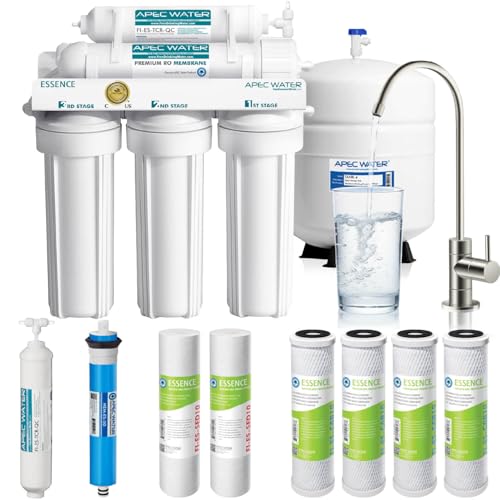
Best for: Households that want proven 5-stage filtration with easy DIY maintenance and low long-term cost. Why it made the list: The APEC ROES-50 uses a 5-stage filtration process that includes sediment, carbon, and reverse osmosis membrane to reduce up to 99% of contaminants like lead, chlorine, and fluoride. It has a dedicated faucet, comes with all necessary parts for installation, and filters last 6-12 months. Owner reviews consistently praise its reliability and water taste.
- Key specs: 5 stages, 50 GPD, includes faucet and tank, NSF certified for material safety only.
- What we like: Easy to install with clear instructions; filters are widely available and reasonably priced; produces clean, great-tasting water; durable metal fittings.
- What we do not like: Slow flow rate (fills a glass in about 30 seconds); tank takes up under-sink space; plastic tubing can kink if not handled carefully.
- Who should buy it: Homeowners who want a reliable, no-frills RO system and don’t mind a tank.
- Who should avoid it: Those with very limited under-sink space or who need fast water dispensing.
- Common complaints: Some users report slow flow after a year due to membrane clogging; occasional leaking at quick-connect fittings if not seated properly.
- Size note: Requires about 12 inches of depth under the sink for the tank; fits most standard cabinets.
- Cleaning note: Sanitize the system annually with a bleach solution to prevent bacterial growth.
- Alternative: iSpring RCC7 for higher 75 GPD flow and added carbon stage if you want more contaminant reduction.
Reverse Osmosis System Buying Guide
Filtration Stages and Certifications
Look for at least 4 stages: sediment, carbon, RO membrane, and post-carbon. More stages can improve taste but increase filter cost. NSF certifications (e.g., NSF 58 for performance) ensure the system reduces specific contaminants. Not all systems are certified, but those that are give peace of mind.
Flow Rate and Water Waste
Flow rate is measured in gallons per day (GPD). Standard 50 GPD systems take about 30 seconds to fill a glass. High-flow tankless systems (like 800 GPD) dispense water instantly but cost more and may waste more water. Check the water waste ratio; modern systems can achieve 1:1 or better, meaning one gallon of waste per gallon of filtered water.
Installation and Maintenance
Most under-sink systems are DIY-friendly with basic tools. Consider the space under your sink: tanks can take up significant room. Filter replacement frequency varies; typical schedules are every 6-12 months for pre-filters and 2-3 years for the membrane. Factor in annual filter costs when comparing systems.
Safety Notes
- Always install a dedicated faucet to avoid cross-contamination.
- Replace filters on schedule to prevent bacterial growth.
- Sanitize the system annually with food-grade hydrogen peroxide or bleach.
- Check for lead-free certifications on faucets and fittings.
What to Avoid
- Avoid systems with plastic threaded fittings that are prone to cracking and leaking.
- Avoid systems that claim to remove all contaminants without NSF certification.
- Avoid systems with proprietary filters that are expensive or hard to find.
- Avoid tankless systems with very high water waste ratios (e.g., 3:1 or worse).
FAQ
Do reverse osmosis systems remove beneficial minerals?
Yes, RO removes nearly all minerals, including calcium and magnesium. Some systems have a remineralization stage, or you can add minerals back with a separate cartridge.
How often do I need to change filters?
Pre-filters typically every 6-12 months, the RO membrane every 2-3 years. Follow the manufacturer’s schedule.
Can I install an RO system myself?
Yes, most under-sink systems come with detailed instructions and require only basic tools like a drill for the faucet hole. Many homeowners can do it in an afternoon.
Final Verdict
The APEC Water Systems ROES-50 is the best reverse osmosis system for home use because it combines reliable 5-stage filtration, easy DIY installation, and low long-term costs. If you prefer a tankless design with faster flow, the Waterdrop G3P800 is a great value. For tight budgets, the Express Water 5-stage offers solid performance. Avoid generic systems with plastic fittings that can leak.
