The Boogie Blue Plus is the best hose water filter for garden vegetables because it is one of the few inline hose filters built specifically for gardens, targeting both chlorine and the harder-to-remove chloramine that many municipal systems now use, with enough capacity to last a full growing season. Chlorinated tap water will not kill your vegetables, but it can suppress the soil microbes and compost teas organic gardeners work hard to cultivate. We compared garden and RV inline filters to find the ones that actually deliver for edible beds.
The Boogie Blue Plus is the best hose water filter for garden vegetables, removing chlorine and chloramine at hose flow rates with a full-season capacity rating. The Camco TastePURE is the best budget option if your city uses plain chlorine rather than chloramine.
- Best overall: Boogie Blue Plus Garden Hose Filter
- Best value: Clear2O Inline Hose Water Filter
- Best budget: Camco TastePURE Inline Water Filter
- Avoid: Reusing last season’s spent filter, exhausted media removes almost nothing
Affiliate Disclosure: As an Amazon Associate, we earn from qualifying purchases. This does not affect our product rankings or recommendations.
Quick Picks
- Best overall: Boogie Blue Plus Garden Hose Filter, Purpose-built for gardens, handles chlorine and chloramine for a full season.. Check price on Amazon
- Best value: Clear2O Inline Hose Water Filter, Fine one micron filtration that also strips sediment for cleaner drip lines..
- Best budget: Camco TastePURE Inline Water Filter, The ubiquitous RV filter, cheap, everywhere, and fine for chlorine-only systems..
Comparison Table
| Hose filter | Targets | Best for | Rated capacity | Buy |
|---|---|---|---|---|
| Boogie Blue Plus | Chlorine, chloramine, some heavy metals | Organic vegetable beds | Roughly a full season, tens of thousands of gallons | Check Price |
| Clear2O Inline Filter | Chlorine, sediment down to 1 micron | Drip irrigation systems | One season of typical use | Check Price |
| Camco TastePURE | Chlorine, taste, odor, coarse sediment | Chlorine-only water systems | About three months of regular use | Check Price |
| Waterdrop RV Inline Filter | Chlorine, taste, odor, sediment | Multi-hose setups on a budget | About three months of regular use | Check Price |
How We Chose These Hose Water Filter Picks
We compared filtration media, chloramine capability, rated gallon capacity, and flow rate across the most widely used inline hose filters, then reviewed aggregated feedback from vegetable gardeners running them through full seasons. Filters that only handle chlorine were kept honest, they are cheaper but the wrong choice for chloraminated water.
Key Takeaway: Find out whether your utility uses chlorine or chloramine before buying, most cheap hose filters barely touch chloramine and that single fact should drive your choice.
Best Overall: Boogie Blue Plus Garden Hose Filter
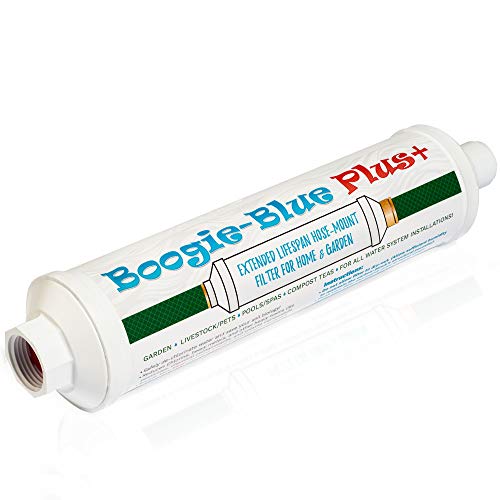
Best for: Vegetable gardeners on municipal water who want to protect soil biology, compost teas, and beneficial microbes from chlorine and chloramine. Why it made the list: It combines KDF media and catalytic carbon to address chlorine and chloramine at real hose flow rates, and its high rated capacity means one filter typically covers an entire growing season.
- Key specs: Inline garden hose filter with standard hose threading, KDF plus granular activated carbon media, rated for chlorine, chloramine, and reduction of some heavy metals, season-long rated capacity in the tens of thousands of gallons.
- What we like: It is one of the few hose filters designed for gardens rather than RVs, it does not choke flow the way finer RV filters can, and the seasonal capacity keeps cost per watering low.
- What we do not like: Chloramine reduction at full hose blast is partial rather than complete, there is no gauge telling you when the media is spent, and it costs more than the RV filters it competes with.
- Who should buy it: Organic growers, anyone brewing compost tea, and gardeners whose utility report lists chloramine as the disinfectant.
- Who should avoid it: Gardeners on well water without chlorination, you have nothing for this filter to remove, spend the money on a sediment filter if your issue is grit.
- Common complaints: Owners most often mention uncertainty about when the filter is exhausted and modest flow reduction on low-pressure spigots.
- Size note: It is a compact inline cylinder that threads between spigot and hose, leave a gentle strain-relief loop so hose weight does not torque the housing.
- Cleaning note: There is nothing to clean inside, flush it for a minute on first use, drain it before frost, and replace the unit when its rated season is done.
- Alternative: If your water report shows chlorine only, the cheaper Camco TastePURE does the job for a typical three month stretch.
Garden Hose Water Filter Buying Guide
Chlorine versus chloramine
Check your utility’s annual water quality report first. Plain chlorine dissipates if water sits in a barrel overnight and any carbon filter removes it easily, but chloramine is stable, it will not off-gas, and it requires catalytic carbon or KDF media and slower flow to reduce meaningfully. Buying a chlorine-only filter for chloraminated water is the most common mistake in this category.
Does your garden really need one
Be honest about the benefit, typical municipal disinfectant levels rarely harm established vegetables, the stronger case is protecting soil microbiology, compost teas, and mycorrhizal inoculants, which chlorinated water can suppress at the soil surface. If you garden in containers with frequent watering or brew teas, filtration makes more sense than for a mulched in-ground bed.
Flow rate and capacity
Every filter trades flow for contact time, and slower water gets cleaner water. Look at rated gallon capacity against your real usage, a vegetable garden can easily take thousands of gallons per season, so a filter rated around 10,000 gallons or more spares you mid-season replacements. Drip systems benefit from finer sediment filtration to keep emitters clear.
Safety Notes
- Do not drink from a garden hose even with a filter, most garden hoses are not rated as drinking-water safe.
- Drain and store the filter above freezing, ice expansion cracks housings.
- Replace media on schedule, exhausted carbon can slough accumulated material back into the flow.
- Keep a backflow preventer on the spigot so fertilizer siphoning cannot reach household plumbing.
What to Avoid
- Chlorine-only filters if your utility report says chloramine.
- Claims of removing everything at full hose flow, contact time physics says otherwise.
- Filters with no rated gallon capacity listed at all.
- Leaving a filter pressurized and baking in direct summer sun, heat degrades media and housings.
FAQ
Does chlorinated water actually hurt vegetable plants?
Established plants tolerate typical municipal chlorine levels fine, the roots and soil buffer it. The concern is soil life, chlorinated and especially chloraminated water can suppress beneficial microbes and undo the value of compost teas, which is why organic growers filter.
How long does a hose water filter last?
Compact RV-style filters like the Camco TastePURE are rated for roughly three months of regular use, while the Boogie Blue Plus is rated to cover a full growing season. Heavy daily watering shortens all of these ratings, so track your usage rather than the calendar alone.
Will a hose filter fix hard water spots on my plants?
No, hardness minerals like calcium pass straight through carbon and KDF filters. These filters target chlorine, chloramine, taste, and sediment, if hardness is your real complaint you would need a softening or spot-free rinse system, which is rarely worthwhile for a garden.
Final Verdict
The Boogie Blue Plus is the best hose water filter for garden vegetables because it targets chloramine as well as chlorine with a full-season capacity, with the Clear2O Inline Hose Water Filter adding fine sediment protection that drip systems love and the Camco TastePURE covering chlorine-only towns for pocket change.
