Updated 19 July 2026 · Specifications and Amazon availability checked 19 July 2026 · Written by Daniel Wright
A nonstick pan makes eggs, fish and delicate food effortless and cleanup a wipe, but coatings wear out and differ in what they can take. Traditional nonstick releases best and lasts a few years; ceramic nonstick avoids the chemicals some cooks prefer to skip. We compared five so you can match release, durability and coating type to how you cook. We did not run a coating-life lab, so each score is a research-based composite from manufacturer specifications and owner feedback.
For most kitchens the T-fal Ultimate is the best value nonstick pan. Want premium durability? The All-Clad HA1. Prefer coating-free ceramic without the chemicals some avoid? The Made In CeramiClad or GreenPan.
- Best value: T-fal Ultimate · Check price
- Best premium: All-Clad HA1 · Check price
- Best mid-range: OXO Good Grips · Check price
- Best ceramic: Made In CeramiClad · Check price
- Best ceramic set: GreenPan Valencia Pro · Check price
Affiliate Disclosure: As an Amazon Associate we earn from qualifying purchases. This never changes our rankings, and the specifications below come from each manufacturer’s current listing.
Side-by-Side Comparison
| Nonstick pan | Coating | Oven safe | PFAS-free | Best for | Buy |
|---|---|---|---|---|---|
| T-fal Ultimate | Traditional nonstick | 400 F | No | Value | Check price |
| All-Clad HA1 | Traditional nonstick | 500 F | No | Premium durability | Check price |
| OXO Good Grips | Traditional (PFOA-free) | 430 F | No | Mid-range | Check price |
| Made In CeramiClad | Ceramic | Yes | Yes | Coating-free | Check price |
| GreenPan Valencia | Ceramic | Yes | Yes | Ceramic value | Check price |
How We Evaluated These Picks
We are a research desk, not a lab, so we did not measure coating life with instruments. We compared release and how effortlessly food comes away, durability and how long the coating lasts, oven safety and heat tolerance, whether the coating is PFAS-free, and long-run owner feedback. The composite score is weighted as follows.
- Release and cooking performance: 30%
- Coating durability: 25%
- Heat and oven safety: 20%
- Handle and build: 15%
- Value: 10%
Traditional Nonstick vs Ceramic
Nonstick pans use one of two coatings. Traditional nonstick, made with PTFE, releases food best, is the most durable coating type and tolerates a little more heat, but it contains fluoropolymers some cooks prefer to avoid and still wears out in a few years. Modern versions are PFOA-free, addressing the older health concern.
Ceramic nonstick, like the Made In and GreenPan, uses a sand-based coating that is free of PFAS chemicals entirely, which appeals to the health-conscious, and it often releases beautifully when new. The trade-off is that ceramic nonstick typically loses its release faster than traditional nonstick. Whichever you choose, all nonstick dislikes high heat and metal utensils, so keep it to low-to-medium heat with wood or silicone tools, and expect to replace it every few years.
Best Value: T-fal Ultimate

Research-based composite: 8.7 / 10 · Best for: Beginners and busy cooks who want reliable easy release for little
Specifications
| Coating | Traditional nonstick |
| Oven safe | 400 F |
| Feature | Thermo-Spot |
| PFAS-free | No |
| Best for | Value |
| Brand | T-fal |
The T-fal Ultimate is the forgiving value nonstick pan. Its hard-anodized body is durable for nonstick, the coating releases eggs, fish and delicate food with almost no oil, and T-fal’s Thermo-Spot indicator turns solid when the pan is properly preheated, which genuinely helps beginners. It is oven safe to 400 degrees, dishwasher safe and affordable.
Like all nonstick the coating wears out in a few years, dislikes high heat and metal utensils, and it contains PTFE rather than being ceramic. But for easy everyday cooking at a low price it is excellent. Who should skip it: anyone wanting a PFAS-free ceramic pan or the longest life. Pros: easy release, preheat indicator, oven safe, affordable. Cons: coating wears, low heat only, not PFAS-free.
Model reviewed: T-fal Ultimate Hard Anodized Nonstick Fry Pan, ASIN B00EXLOVU2
Best Premium: All-Clad HA1
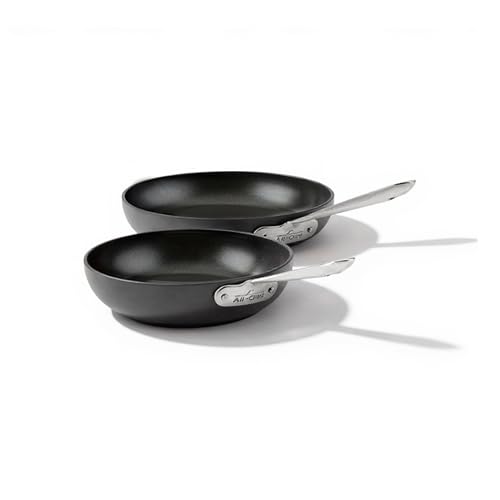
Research-based composite: 9.1 / 10 · Best for: Cooks who want the most durable nonstick with high oven safety
Specifications
| Coating | Traditional nonstick |
| Oven safe | 500 F |
| Layers | 3, PFOA-free |
| Body | Hard-anodized |
| Best for | Premium |
| Brand | All-Clad |
The All-Clad HA1 is the premium traditional nonstick pan. Its hard-anodized body is heavy and even-heating, the three-layer PFOA-free nonstick coating is among the most durable and lasts longer than budget pans, and it is oven safe to a high 500 degrees. A sturdy stainless handle and solid build make it feel like a lifetime pan, even though the coating itself will eventually wear.
It is expensive for a nonstick pan, and like all nonstick it still dislikes metal utensils and very high stovetop heat. But for durability and even heating it is the best here. Who should skip it: budget buyers or anyone wanting ceramic. Pros: durable coating, even heating, high oven safety, premium build. Cons: expensive, still wears eventually.
Model reviewed: All-Clad HA1 Hard Anodized Nonstick Fry Pan, ASIN B0170TFNXM
Best Mid-Range: OXO Good Grips
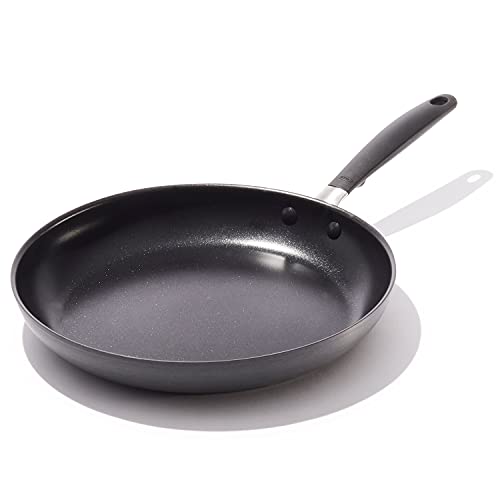
Research-based composite: 8.6 / 10 · Best for: Cooks who want a comfortable, PFOA-free nonstick pan at a fair price
Specifications
| Coating | PFOA-free nonstick |
| Oven safe | 430 F |
| Handle | Stay-cool |
| Body | Hard-anodized |
| Best for | Mid-range |
| Brand | OXO |
The OXO Good Grips nonstick pan balances quality and price. Its hard-anodized body heats evenly, the PFOA-free coating releases food well, and the comfortable, stay-cool handle OXO is known for makes it a pleasure to use. It is oven safe to a useful 430 degrees and feels sturdier than budget pans without the premium price.
As with all nonstick the coating has a finite life and needs gentle utensils and moderate heat, and it is PTFE rather than ceramic. But for a comfortable, well-built mid-range nonstick pan it is a strong pick. Who should skip it: anyone wanting ceramic or the absolute longest life. Pros: even heating, comfortable handle, PFOA-free, good oven safety. Cons: coating wears, low-to-medium heat only.
Model reviewed: OXO Good Grips Hard Anodized Nonstick Fry Pan, ASIN B00PCI6XP6
Best Ceramic: Made In CeramiClad

Research-based composite: 8.8 / 10 · Best for: Cooks who want a durable ceramic nonstick free of PFAS chemicals
Specifications
| Coating | Ceramic |
| PFAS-free | Yes |
| Oven safe | Yes |
| Body | Heavier |
| Best for | Coating-free |
| Brand | Made In |
The Made In CeramiClad is the premium ceramic nonstick pan. Its sand-based ceramic coating is completely free of PFAS chemicals, it releases food cleanly, and Made In pairs it with a heavier, better-built body than most ceramic pans, so it heats evenly and tolerates the oven. For cooks who want coating-free release with quality construction, it is a standout.
Ceramic nonstick generally loses its release faster than traditional nonstick, and it is expensive. But for a well-made PFAS-free pan it is the best here. Who should skip it: anyone who wants the longest-lasting release or the lowest price. Pros: PFAS-free ceramic, even heating, quality build, oven safe. Cons: ceramic fades faster, pricey.
Model reviewed: Made In CeramiClad Nonstick Fry Pan, ASIN B0GXX6QGJ2
Best Ceramic Value: GreenPan Valencia Pro

Research-based composite: 8.4 / 10 · Best for: Cooks who want PFAS-free ceramic nonstick at a friendlier price
Specifications
| Coating | Ceramic Thermolon |
| PFAS-free | Yes |
| Oven safe | Yes |
| Body | Hard-anodized |
| Best for | Ceramic value |
| Brand | GreenPan |
The GreenPan Valencia Pro is the value ceramic nonstick choice. Its Thermolon ceramic coating is free of PFAS chemicals, releases food easily when new, and the hard-anodized body heats evenly and is oven safe. Often sold as a set, it is a more affordable way into coating-free cooking than premium ceramic pans.
Like all ceramic nonstick its release fades faster than traditional coatings, and it needs low-to-medium heat and gentle utensils. But for PFAS-free ceramic at a fair price it is a good pick. Who should skip it: anyone wanting the most durable release. Pros: PFAS-free, easy release, even heating, oven safe, good value. Cons: ceramic fades faster, low-to-medium heat only.
Model reviewed: GreenPan Valencia Pro Ceramic Nonstick Fry Pan, ASIN B09HTBCT3W
Which Nonstick Pan Should You Buy?
Best value
The T-fal Ultimate, forgiving and affordable with a helpful preheat indicator.
Best premium
The All-Clad HA1, the most durable traditional nonstick with high oven safety.
Best PFAS-free
A ceramic pan, the Made In CeramiClad or the GreenPan, both free of the chemicals some cooks avoid.
Best comfortable everyday pan
The OXO Good Grips, with an even body and a stay-cool handle at a fair price.
Best for eggs and delicate food
Any of these; nonstick and ceramic both release eggs and fish effortlessly when in good condition.
Buying Guide
Traditional or ceramic
Traditional nonstick releases best and lasts longest but contains PTFE; ceramic is PFAS-free and releases well when new but fades faster. Choose durability or coating-free peace of mind.
All nonstick wears out
Every coating has a finite life, usually a few years. Low heat, gentle utensils and hand washing extend it, but plan to replace nonstick pans periodically.
Keep the heat moderate
Nonstick and ceramic dislike high heat, which degrades the coating and can release fumes. Use low-to-medium heat and sear on stainless or cast iron instead.
Use gentle utensils
Wood, silicone or nylon tools protect the coating; metal scratches and shortens its life. Never cut in the pan.
Care and Longevity
- Cook on low to medium heat only; high heat degrades any nonstick coating fastest.
- Use wood, silicone or nylon utensils, never metal.
- Hand wash to extend the coating, even if the pan is dishwasher safe.
- Avoid cooking sprays, which leave a residue that builds up and ruins release.
Frequently Asked Questions
Is ceramic or traditional nonstick better?
Traditional nonstick releases best and lasts longest but contains PTFE; ceramic is free of PFAS chemicals and releases well when new but its coating fades faster. Choose durability or coating-free peace of mind.
How long do nonstick pans last?
Usually two to five years with careful use. Low heat, gentle utensils and hand washing extend the coating; high heat, metal tools and dishwashing shorten it. Ceramic often fades sooner than traditional nonstick.
Are nonstick pans safe?
Modern nonstick pans are PFOA-free, addressing the older health concern, and are safe used correctly at low-to-medium heat. Overheating any nonstick can release fumes, so keep the heat moderate. Ceramic pans avoid PFAS entirely.
Can you use metal utensils on nonstick?
No. Metal utensils scratch and damage both traditional and ceramic nonstick coatings, shortening their life. Use wood, silicone or nylon tools, and never cut food in the pan.
Sources and References
Specifications were checked against each manufacturer’s Amazon listing on 19 July 2026 (T-fal, All-Clad, OXO, Made In and GreenPan). Where a maker does not state a figure, we describe the design rather than invent a number.
Final Verdict
For most kitchens the T-fal Ultimate is the best value nonstick pan: forgiving, affordable and easy to use. The All-Clad HA1 is the premium pick for the most durable coating and high oven safety, the OXO Good Grips is the comfortable mid-range choice, and the Made In CeramiClad and GreenPan are the PFAS-free ceramic options for cooks who avoid traditional coatings. Choose traditional nonstick for durability or ceramic for coating-free peace of mind, keep the heat moderate, and plan to replace any nonstick pan every few years.