The Fellow Eddy Steaming Pitcher is the best milk pitcher for latte art because its sharp fluted spout gives you fine control over pour speed and line width, which is exactly what hearts, tulips, and rosettas demand. Your pitcher matters as much as your steaming technique; a vague rounded spout produces vague blobby art no matter how good your microfoam is. Below are four pitchers covering precision pouring, barista-standard training, and budget practice options.
The Fellow Eddy Steaming Pitcher is the best milk pitcher for latte art thanks to its precise fluted spout and comfortable balance. The Rattleware Latte Art Pitcher is the value pick trusted in cafes, and the Update International frothing pitcher is the budget way to practice.
- Best overall: Fellow Eddy Steaming Pitcher
- Best value: Rattleware Latte Art Pitcher
- Best budget: Update International Frothing Pitcher
- Avoid: Oversized pitchers; steaming 6 ounces of milk in a 32-ounce pitcher ruins texture
Affiliate Disclosure: As an Amazon Associate, we earn from qualifying purchases. This does not affect our product rankings or recommendations.
Quick Picks
- Best overall: Fellow Eddy Steaming Pitcher, A sharp fluted spout and balanced handle that make thin, controlled pours much easier.. Check price on Amazon
- Best value: Rattleware Latte Art Pitcher, The long-time cafe standard with a pointed spout and durable stainless build..
- Best budget: Update International Frothing Pitcher, Basic restaurant-supply stainless that steams fine while you learn the fundamentals..
Comparison Table
| Pitcher | Capacity | Best for | Spout style | Buy |
|---|---|---|---|---|
| Fellow Eddy | 12 or 18 oz | Precise latte art pouring | Sharp fluted point | Check Price |
| Rattleware Latte Art Pitcher | 12 or 20 oz | Cafe-style training and daily use | Pointed | Check Price |
| Zulay Kitchen Frothing Pitcher | 12 oz | Home machines with measurement lines | Rounded point | Check Price |
| Update International Frothing Pitcher | 20 oz | Budget practice and batch steaming | Standard round | Check Price |
How We Chose These Coffee Makers Picks
We compared spout geometry, capacity options, steel gauge, and handle design across the most popular pitchers, then weighed aggregated feedback from home baristas and cafe workers. Spout precision and correct sizing for typical home espresso machines counted most, since those two factors decide whether latte art is even possible.
Key Takeaway: Buy a pitcher sized to your drinks, not bigger: 12 ounces for single lattes, 18 to 20 ounces for two drinks. A sharp spout is what turns decent microfoam into actual art.
Best Overall: Fellow Eddy Steaming Pitcher
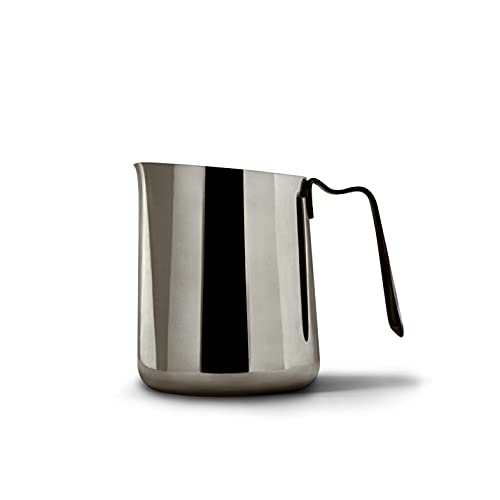
Best for: Home baristas who have basic steaming down and want a spout that makes rosettas and tulips dramatically easier to draw. Why it made the list: The fluted, sharply pointed spout channels milk into a thin consistent ribbon, and the balanced handle encourages the wrist-led pouring motion latte art requires.
- Key specs: Stainless steel body, sharply fluted pour spout, 12-ounce and 18-ounce sizes, ergonomic handle, matte and polished finish options.
- What we like: The spout produces a thin controllable stream that makes line work noticeably crisper, and the pitcher balance makes slow wiggle pours feel natural instead of shaky.
- What we do not like: It costs several times what a basic frothing pitcher does, and the fluted spout design demands decent microfoam; it will not hide texture mistakes.
- Who should buy it: Espresso owners who steam milk daily and are actively working on latte art patterns beyond a basic heart.
- Who should avoid it: Beginners still learning to stretch milk, and anyone using a low-power frother rather than a real steam wand; a budget pitcher teaches the same fundamentals for far less.
- Common complaints: Owners mention the premium price, occasional finish scratching on the matte version, and that 12 ounces feels tight for two-drink households.
- Size note: Choose the 12-ounce for single 8 to 10 ounce lattes and the 18-ounce if you regularly steam for two drinks at once.
- Cleaning note: Rinse immediately after steaming and hand wash; dried milk film dulls the interior and is much harder to scrub off later.
- Alternative: The Rattleware Latte Art Pitcher delivers most of the same pour control in a plainer package that many cafes have used for years.
Milk Pitcher Buying Guide
Spout shape decides your art
A sharp, narrow spout produces the thin milk ribbon needed for defined rosetta leaves and tulip stacks, while a rounded spout pours wide and soft, which suits basic hearts but blurs detail. Fluted spouts add even more channel control. If latte art is the goal, spout geometry is the single most important spec on the page.
Match capacity to your drinks
Milk expands when stretched, and a pitcher steams best between one-third and half full. That means a 12-ounce pitcher suits one latte, and 18 to 20 ounces suits two. Oversized pitchers are the most common beginner mistake because small volumes of milk in a big pitcher spin poorly and overheat before texturing.
Steel gauge and handle feel
Thicker stainless holds temperature evenly and dents less, while very thin budget steel heats up fast and can scorch your hand. A handle with an open, forward grip supports the wrist-tilting motion of pouring. Measurement markings inside are handy for consistency but not essential.
Safety Notes
- Steam wand tips and pitcher walls get scalding hot; grip the handle, not the body, right after steaming.
- Purge the steam wand away from your hand before and after steaming to avoid hot spurts.
- Do not steam milk past roughly 150 to 160 degrees; overheated milk can scald and also tastes flat.
- Check the pitcher rim for dents or sharp edges over time, especially on thin budget steel.
What to Avoid
- Buying a 30-ounce pitcher for single home lattes; it ruins milk texture at small volumes.
- Rounded utility spouts if you specifically want defined latte art patterns.
- Very thin-gauge steel that transmits heat instantly to your fingers.
- Running milk pitchers through the dishwasher constantly; milk film and water spots build up faster than with a quick hand rinse.
FAQ
What size milk pitcher is best for latte art?
For a single 8 to 12 ounce latte, a 12-ounce pitcher is ideal because milk textures best when the pitcher is one-third to half full. For two drinks, step up to 18 or 20 ounces. Bigger than that only makes sense for batch steaming in a cafe setting.
Does the pitcher really affect latte art?
Yes, meaningfully. The spout controls the width and speed of the milk ribbon hitting the espresso, so a sharp spout produces crisp lines while a round one produces soft blobs. Technique and microfoam quality still matter most, but a precise spout raises your ceiling.
Should I get a Teflon or coated milk pitcher?
Bare stainless is the standard and the safest long-term choice since there is no coating to chip. Coated pitchers look sharp but show scratches, and any coating flaking near food is a reason to replace them. If in doubt, plain polished stainless is the durable option.
Final Verdict
The Fellow Eddy Steaming Pitcher is the best milk pitcher for latte art, with the Rattleware Latte Art Pitcher offering cafe-proven pour control for less and the Update International Frothing Pitcher covering budget practice while you build technique.
Related Guides
- Best Latte Machine with Milk Frother in 2026: Rich Espresso and Silky Microfoam
- Best Automatic Milk Frother in 2026
- Best Handheld Milk Frother in 2026: Cafe Foam Without the Espresso Machine
- Best Coffee Makers in 2026: Drip, Single-Serve and Grind-and-Brew Picks
- Best Drip Coffee Makers in 2026: Hot, Even-Brewing Picks
- All Coffee Makers guides