The Wusthof Classic 8-Inch Chef’s Knife is the best left handed kitchen knife because its perfectly symmetric 50/50 edge and neutral handle work identically in either hand, with the fit and finish to last decades. Here is the honest truth about this category, most left-handed cooks do not need a special lefty knife, they need a knife with a symmetric edge grind and an ambidextrous handle, and they need to avoid the right-biased designs like single-bevel Japanese blades and D-shaped handles. All four picks below are genuinely neutral in a left hand.
The Wusthof Classic 8-Inch Chef’s Knife is the best kitchen knife for left-handed cooks, with a fully symmetric edge and neutral handle that perform identically in either hand. The Mercer Culinary Millennia is the budget pick with the same ambidextrous geometry.
- Best overall: Wusthof Classic 8-Inch Chef’s Knife
- Best value: Victorinox Fibrox Pro 8-Inch Chef’s Knife
- Best budget: Mercer Culinary Millennia 8-Inch Chef’s Knife
- Avoid: Single-bevel Japanese knives and D-shaped handles sold without a left-handed version, they actively fight a left hand
Affiliate Disclosure: As an Amazon Associate, we earn from qualifying purchases. This does not affect our product rankings or recommendations.
Quick Picks
- Best overall: Wusthof Classic 8-Inch Chef’s Knife, A symmetric 50/50 edge and neutral handle that cut identically in either hand.. Check price on Amazon
- Best value: Victorinox Fibrox Pro 8-Inch Chef’s Knife, Light, grippy, and truly ambidextrous at a working-kitchen price..
- Best budget: Mercer Culinary Millennia 8-Inch Chef’s Knife, Culinary school standard with a neutral grip and easy-to-maintain edge..
Comparison Table
| Knife | Steel and edge | Best for | Handle | Buy |
|---|---|---|---|---|
| Wusthof Classic 8-Inch | Forged German steel, 50/50 edge | A lifetime daily driver | Symmetric POM, full tang | Check Price |
| Victorinox Fibrox Pro 8-Inch | Stamped stainless, 50/50 edge | Value and low maintenance | Grippy neutral Fibrox | Check Price |
| Mercer Culinary Millennia 8-Inch | Stamped Japanese steel, 50/50 edge | Budget buyers and students | Textured ambidextrous grip | Check Price |
| Global G-2 8-Inch | Cromova 18, symmetric convex edge | Cooks who prefer light knives | Dimpled steel, fully neutral | Check Price |
How We Chose These Left Handed Kitchen Knife Picks
We verified edge geometry and handle symmetry from manufacturer specifications, since a left-handed knife lives or dies on a 50/50 bevel and a neutral grip, then compared steel, weight, and aggregated feedback from left-handed owners on comfort during extended prep. Knives with any right-hand bias in the grind or handle were disqualified.
Key Takeaway: For a lefty, edge symmetry matters more than brand. A 50/50 double bevel and a neutral handle make a knife fully left-handed, while single-bevel blades and D-handles never will be.
Best Overall: Wusthof Classic 8-Inch Chef’s Knife
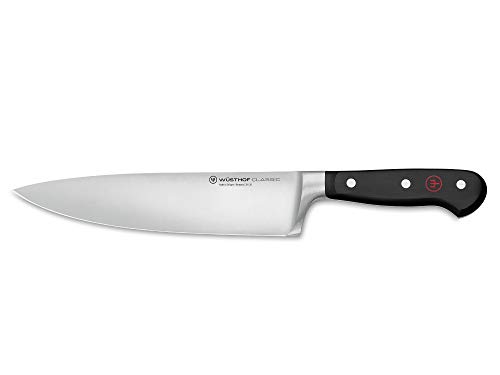
Best for: Left-handed cooks who want one excellent knife that will handle decades of daily prep without compromise. Why it made the list: Its precision edge is ground to an equal angle on both sides, the handle has no finger-notch bias or D-profile, and the forged German steel takes sharpening from either direction, so nothing about the knife assumes which hand holds it.
- Key specs: 8 inch forged blade, high-carbon German stainless steel, precision computer-controlled 50/50 edge, full tang, symmetric polymer handle, full bolster.
- What we like: The balance and heft do the work in long prep sessions, the edge holds well between honings, and the symmetric grind means a lefty gets the exact same cutting behavior a righty does.
- What we do not like: It is a premium purchase, the full bolster complicates sharpening the heel of the blade, and at around 8.5 ounces it is noticeably heavier than Japanese-style options.
- Who should buy it: Left-handed cooks tired of knives that steer in their hand, and anyone buying one serious knife instead of a block full of mediocre ones.
- Who should avoid it: Cooks who prefer a featherweight, nimble blade, the Global G-2 suits them better, and casual cooks who would be equally happy with the Victorinox at a fraction of the cost.
- Common complaints: Price, the weight for smaller hands, and the bolster making heel sharpening awkward on home stones. Counterfeit listings from third-party sellers also come up, so buy from reputable sellers.
- Size note: The 8 inch blade is the standard do-everything length. Cooks with smaller hands or cramped cutting boards may prefer the 6 inch version of the same knife.
- Cleaning note: Hand wash and dry immediately. Dishwashers batter the edge against racks and slowly degrade the handle, and this is a knife worth a 20 second hand wash.
- Alternative: If you want the same neutrality at a working-kitchen price, the Victorinox Fibrox Pro is the knife countless culinary students learn on, in either hand.
Kitchen Knife Buying Guide
What makes a knife left-handed
A knife becomes handed in two places, the edge and the handle. A 50/50 double bevel cuts straight for anyone, while a 70/30 or single-bevel grind steers in a left hand and drags cuts off line. Handles with D-profiles or right-side finger scallops force an awkward grip. All four picks here are symmetric in both respects.
Watch out for these designs
Traditional Japanese single-bevel knives like yanagiba and usuba are ground right-handed by default, and left-handed versions are special orders at a premium. Some Japanese handles, including the classic D-shape on certain Shun lines, are shaped for right hands. Serrated bread knives are also frequently ground on one side only, so check before buying.
Steel, weight, and maintenance
German blades like the Wusthof run softer and tougher, forgiving board contact and honing back to sharp easily. Japanese-style blades like the Global run harder and thinner, staying sharp longer but chipping more easily. For a lefty, either works, since sharpening a 50/50 edge is identical in both directions. Buy a honing rod either way.
Safety Notes
- A dull knife slips and cuts hands more often than a sharp one, keep your edge maintained.
- Use a stable cutting board with a damp towel underneath, and curl your guiding fingers into a claw.
- Never try to catch a falling knife, step back and let it drop.
- Store knives on a magnetic strip, in-block, or with edge guards, loose knives in drawers cut reaching hands.
What to Avoid
- Single-bevel Japanese knives unless you specifically order the left-handed grind.
- D-shaped and finger-notched handles that assume a right-hand grip.
- One-side-ground serrated knives, they wander badly when a lefty saws with them.
- Buying a huge knife block, one great symmetric chef’s knife covers most prep.
FAQ
Do left-handed people need special kitchen knives?
Usually not. Any knife with a symmetric 50/50 edge and a neutral handle, which includes most Western chef’s knives, works identically in either hand. Lefties only need special versions for single-bevel Japanese knives, some serrated blades, and D-shaped handles.
Can a left-handed person use a Japanese knife?
Double-bevel Japanese knives like most gyuto and santoku models work fine for lefties, and the Global G-2 in this guide is an example. The exceptions are traditional single-bevel blades like yanagiba, which need a left-handed grind, and D-shaped handles shaped for right hands.
How should a lefty sharpen a kitchen knife?
Exactly like anyone else, since a 50/50 edge is symmetric. Hold the same angle, roughly 15 to 20 degrees per side, and give both sides equal strokes on the stone. Lefties may find pull-through sharpeners easier to use consistently, though stones give a better edge.
Final Verdict
The Wusthof Classic 8-Inch is the best left handed kitchen knife with its perfectly symmetric edge and decades-long build quality, while the Victorinox Fibrox Pro delivers the same neutrality for far less and the Global G-2 suits lefties who prefer a lighter, harder blade.
