The Breville Juice Fountain Compact is the best juicer for beginners because it combines a wide 3-inch feed chute, a single simple speed, and dishwasher-safe parts in a footprint that fits small counters. If you have never juiced before, the biggest obstacles are prep time and cleanup, and this machine minimizes both. You drop in whole apples or halved oranges, press one button, and rinse a handful of parts when you are done.
The Breville Juice Fountain Compact is the best juicer for beginners thanks to its wide chute, one-speed operation, and quick cleanup. If you want a slow juicer for leafy greens, the Ninja NeverClog Cold Press is the easiest cold press to learn on.
- Best overall: Breville Juice Fountain Compact
- Best value: Hamilton Beach Big Mouth Juice Extractor
- Best budget: Mueller Ultra Power Juicer
- Avoid: No-name slow juicers with narrow chutes and flimsy plastic augers
Affiliate Disclosure: As an Amazon Associate, we earn from qualifying purchases. This does not affect our product rankings or recommendations.
Quick Picks
- Best overall: Breville Juice Fountain Compact, Wide chute, one speed, and fast cleanup make it the easiest first juicer.. Check price on Amazon
- Best value: Hamilton Beach Big Mouth Juice Extractor, Strong motor and a big chute at a friendly cost, with simple assembly..
- Best budget: Mueller Ultra Power Juicer, A basic centrifugal juicer that covers the fundamentals without extras..
Comparison Table
| Juicer | Type | Best for | Cleanup | Buy |
|---|---|---|---|---|
| Breville Juice Fountain Compact | Centrifugal | First-time juicers, small kitchens | Fast, most parts dishwasher safe | Check Price |
| Hamilton Beach Big Mouth Juice Extractor | Centrifugal | Budget shoppers who juice hard produce | Easy, removable parts rinse quickly | Check Price |
| Mueller Ultra Power Juicer | Centrifugal | Occasional juicing on a tight budget | Simple, fewer parts to wash | Check Price |
| Ninja NeverClog Cold Press Juicer | Slow masticating | Leafy greens and quieter mornings | Slower, more small parts to clean | Check Price |
How We Chose These Juicer Picks
We researched the most popular beginner juicers and compared their specs, chute widths, part counts, and warranty terms. We also read through large volumes of owner feedback to see which machines people actually keep using after the first month, since abandoned juicers are the most common outcome for beginners.
Key Takeaway: Beginners quit juicing because of prep and cleanup, not juice quality. Pick the machine you will actually clean, which usually means a wide-chute centrifugal model with few parts.
Best Overall: Breville Juice Fountain Compact
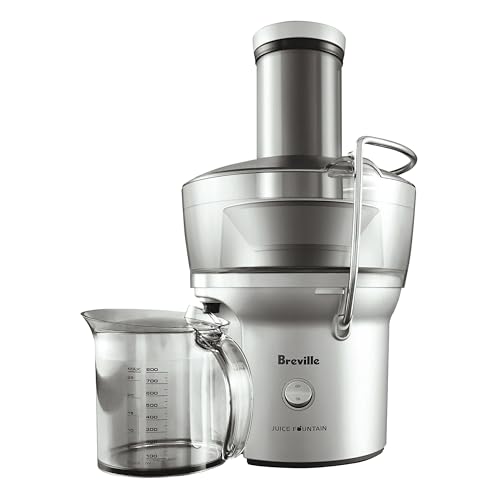
Best for: First-time juicers who want fast juice from apples, carrots, oranges, and celery with minimal prep and a quick rinse afterward. Why it made the list: The Juice Fountain Compact removes the two things that make beginners give up. The 3-inch chute means you barely chop anything, and the short parts list means cleanup takes a few minutes instead of fifteen. The 700-watt motor handles hard produce like carrots and beets without bogging down, the pulp collects inside the footprint of the machine so it does not sprawl across your counter, and the single speed removes any guesswork. Owner feedback consistently praises how quickly people go from produce to finished juice.
- Key specs: 700-watt motor, 3-inch wide feed chute, 25-ounce juice jug, single speed, stainless steel cutting disc, dishwasher-safe parts on the top rack.
- What we like: Whole apples fit in the chute, assembly is obvious without the manual, and the compact footprint stores easily in a cabinet between uses.
- What we do not like: Like all centrifugal juicers it is loud, it produces fairly wet pulp so yield trails a slow juicer, and it struggles with leafy greens like kale and spinach.
- Who should buy it: Anyone starting a juicing habit who mostly wants fruit and hard-vegetable juices and values speed and easy cleanup over maximum yield.
- Who should avoid it: People who mainly want green juice from kale, wheatgrass, or herbs. A masticating juicer extracts far more from leafy greens.
- Common complaints: Owners mention the noise level, foam on top of the juice, and wetter pulp than expected. A few note the pulp bin fills quickly during big batches.
- Size note: The compact body is roughly the size of a large food processor, so it fits under standard cabinets and stores away without a fight.
- Cleaning note: Rinse the mesh filter basket immediately after juicing with the included brush. Dried pulp in the mesh is the hardest thing to remove on any centrifugal juicer.
- Alternative: The Ninja NeverClog Cold Press Juicer if you want higher yield, quieter operation, and better results with greens, and you can accept a slower process.
Juicer Buying Guide
Centrifugal vs slow juicers
Centrifugal juicers shred produce against a spinning mesh basket and make juice in seconds, but they are loud and less efficient with greens. Slow masticating juicers crush produce with an auger, yielding more juice and handling kale well, but they take longer and have narrower feed chutes. Beginners usually stick with the habit longer on a centrifugal machine because the process is faster.
Chute size and prep time
A 3-inch chute swallows whole apples and halved oranges, while a narrow chute forces you to chop everything into strips. Prep time is the hidden cost of juicing, so a wide chute matters more to a beginner than an extra hundred watts of motor power.
Cleanup and part count
Count the parts you will wash every single time: lid, basket, bowl, pulp bin, jug. Machines with dishwasher-safe components and a good cleaning brush get used more often. If the filter basket is hard to rinse, the juicer eventually stays in the cabinet.
Safety Notes
- Never reach into the feed chute while the machine is running. Always use the food pusher.
- Make sure the lid is locked before starting. Most juicers have a safety interlock, but check the arm is fully seated.
- Unplug the juicer before disassembling or cleaning around the blade basket, which is sharp.
- Do not run a centrifugal juicer continuously past the time stated in the manual, as the motor can overheat with hard produce.
What to Avoid
- No-name slow juicers with thin plastic augers, which crack under hard vegetables within months.
- Any juicer with a chute narrower than 2 inches unless you enjoy chopping everything into sticks.
- Models without a safety locking arm or with a flimsy latch that pops open under load.
- Juicers marketed on extreme wattage claims with no reputable brand behind the warranty.
FAQ
Is a centrifugal or a slow juicer better for beginners?
A centrifugal juicer is usually better for beginners because it is faster to use and quicker to clean, which keeps the habit alive. Slow juicers yield more juice and handle greens better, but the extra time and narrower chutes cause many new users to quit. Start fast and simple, then upgrade if you get serious.
How long does fresh juice last?
Juice from a centrifugal machine is best within 24 hours refrigerated in a sealed container, since the fast spinning introduces air and speeds oxidation. Cold press juice typically keeps up to 48 to 72 hours. When in doubt, smell it and look for separation and browning.
Can beginner juicers handle celery and leafy greens?
Celery works in most centrifugal juicers if you cut the stalks to short lengths to avoid string wrap. Leafy greens like kale and spinach yield poorly in centrifugal machines. If greens are your main goal, choose a masticating model like the Ninja NeverClog instead.
Final Verdict
The Breville Juice Fountain Compact is the best juicer for beginners, with a wide chute and quick cleanup that keep the habit going, while the Hamilton Beach Big Mouth Juice Extractor delivers similar convenience for less and the Ninja NeverClog Cold Press Juicer is the pick if leafy greens and yield matter more than speed.
