The Cuisinart Custom 14 (DFP-14BCNY) is the best food processor for pie crust because its strong 720 watt motor and crisp pulse action cut cold butter into flour in seconds, before the fat has any chance to soften. Great pie dough depends on speed and cold, which is exactly what a food processor delivers over hand-cutting. The four machines below all handle a double crust, but they differ in bowl size, pulse feel, and how much you pay for refinement.
The Cuisinart Custom 14 is the best food processor for pie crust, with a big bowl and a decisive pulse that keeps butter cold and dough tender. The Hamilton Beach 10-Cup with Bowl Scraper is the budget route, and the Breville Sous Chef 12 is the upgrade for frequent bakers.
- Best overall: Cuisinart Custom 14, powerful motor and a clean, responsive pulse
- Best value: KitchenAid 7 Cup Food Processor, compact and precise for single crusts
- Best budget: Hamilton Beach 10-Cup with Bowl Scraper, handles a double crust for less
- Avoid: Mini choppers under 4 cups, they overwork the butter before the flour is coated
Affiliate Disclosure: As an Amazon Associate, we earn from qualifying purchases. This does not affect our product rankings or recommendations.
Quick Picks
- Best overall: Cuisinart Custom 14 (DFP-14BCNY), A 720 watt motor, a 14 cup bowl big enough for a double crust, and a pulse that responds instantly.. Check price on Amazon
- Best value: KitchenAid 7 Cup Food Processor, Compact, easy to store, and precise enough for single-crust bakers..
- Best budget: Hamilton Beach 10-Cup Food Processor with Bowl Scraper, Room for a double crust and a built-in scraper at an entry-level outlay..
Comparison Table
| Food processor | Bowl size | Best for | Motor | Buy |
|---|---|---|---|---|
| Cuisinart Custom 14 | 14 cups | Double crusts and big batches | 720 watts | Check Price |
| KitchenAid 7 Cup | 7 cups | Single crusts, small kitchens | Standard duty | Check Price |
| Hamilton Beach 10-Cup | 10 cups | Budget bakers | Entry level | Check Price |
| Breville Sous Chef 12 | 12 cups | Frequent bakers wanting refinement | 1000 watts | Check Price |
How We Chose These Food Processors Picks
We compared spec sheets across the major brands, focusing on motor strength, pulse responsiveness, bowl capacity, and blade quality, the four things that determine pie crust results. We then weighed aggregated owner feedback from home bakers specifically, looking for reports of overheated dough, leaky bowls, and long-term motor durability.
Key Takeaway: For pie crust, pulse control beats raw power. A machine that stops the instant you release the button keeps butter in discrete cold pieces, and that is what makes a crust flaky.
Best Overall: Cuisinart Custom 14 (DFP-14BCNY)
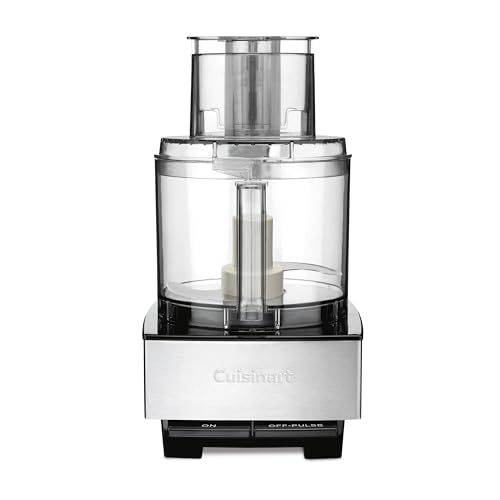
Best for: Bakers who make full-size and double-crust pies and want one machine that also earns its counter space year round. Why it made the list: The Custom 14 has been the default serious home food processor for decades for a reason. The pulse engages and stops instantly, the S-blade is genuinely sharp, and the 14 cup bowl gives a double batch of crust room to toss instead of packing into a paste. It also comes with slicing and shredding discs, so it keeps working after pie season ends.
- Key specs: 720 watt motor, 14 cup work bowl, stainless S-blade plus slicing and shredding discs, simple on, off, and pulse paddle controls.
- What we like: The pulse is immediate and repeatable, which is everything for pastry. The bowl handles a double crust without crowding, and the whole machine feels built to survive a decade of holidays.
- What we do not like: It is heavy and takes up real cabinet space, there is no small bowl insert for little jobs, and the strong motor will overwork dough fast if you hold the button instead of pulsing.
- Who should buy it: Regular bakers, anyone making double-crust or slab pies, and cooks who want one durable machine for shredding, slicing, and dough all year.
- Who should avoid it: Occasional bakers with tight storage, and anyone who mostly makes single crusts. A 7 cup machine does that job in half the footprint.
- Common complaints: Owners mention the weight, a lid that takes practice to seat and lock, and how loud it is at full speed. A few report the bowl’s plastic stress-cracking near the handle after years of dishwasher cycles.
- Size note: At roughly 18 pounds with a tall lid assembly, it wants a permanent counter spot. Measure under-cabinet clearance before buying, since you load the feed tube from the top.
- Cleaning note: The bowl, lid, and blade rinse clean easily since pie dough stays dry and crumbly. Hand washing the bowl preserves the plastic longer than the dishwasher’s top rack.
- Alternative: The Breville Sous Chef 12 costs more but adds an adjustable slicer, a small-batch bowl, and quieter refinement for people who use a processor several times a week.
Food Processor Buying Guide
Why pulse control matters for pie dough
Flaky crust comes from cold butter left in pea-size pieces that steam apart into layers in the oven. A processor with a crisp pulse lets you fire eight to twelve short bursts, checking between them, so the butter never smears into the flour. Machines with mushy or delayed pulse response are the ones that turn crust dense and cookie-like.
Bowl size for single versus double crusts
A single 9 inch crust uses about a cup and a quarter of flour and works fine in a 7 cup bowl. A double crust needs the ingredients to move freely, so a 10 to 14 cup bowl keeps the flour tossing instead of compacting at the bottom. If you also make slab pies or big batches of dough for the freezer, go straight to 12 cups or more.
Motor power and blade sharpness
You do not need extreme wattage for pastry, but you do need enough torque that the blade cuts cold, hard butter instead of stalling and warming it. Around 700 watts and up handles refrigerator-cold butter cleanly. A sharp S-blade matters more than any accessory, since dull blades mash fat rather than slicing it.
Safety Notes
- Never reach into the bowl until the blade has fully stopped spinning. It coasts after you release pulse.
- Handle the S-blade by its plastic hub only, and wash it separately rather than dropping it in soapy water where you cannot see it.
- Make sure the lid is locked before pulsing. Interlocks wear over time, so replace a lid that engages inconsistently.
- Unplug the machine before removing the blade or clearing dough from around the stem.
What to Avoid
- Holding the run button instead of pulsing. Continuous processing smears the butter and toughens the crust.
- Using room-temperature butter. Warm fat blends into the flour instead of staying in flaky pieces.
- Processing until the dough forms a ball. That is a sign the gluten is already overworked.
- Buying a mini chopper for pastry. Bowls under 4 cups crowd the flour and mash the fat.
FAQ
How many pulses does pie crust take in a food processor?
Cut cold cubed butter into the flour with roughly 8 to 12 one-second pulses, stopping when the biggest pieces are pea-size. Then add ice water a tablespoon at a time with two or three pulses between additions, and stop the machine while the dough still looks shaggy rather than forming a ball.
Can I make a double crust in a 7 cup food processor?
You can, but it is tight, and crowded flour compacts instead of tossing, which works the dough more than you want. Either process the two crusts in separate batches or step up to a 10 cup or larger bowl for double-crust pies.
Why did my food processor pie crust turn out tough?
Almost always overprocessing. Once water hits flour, gluten develops with every pulse, so stop while the dough is still crumbly and finish bringing it together by hand. Warm butter is the other culprit, so cube it and chill it hard before it touches the flour.
Final Verdict
The Cuisinart Custom 14 is the best food processor for pie crust, with the KitchenAid 7 Cup Food Processor serving single-crust bakers in compact kitchens and the Hamilton Beach 10-Cup with Bowl Scraper proving a double crust does not require a big outlay.