The OXO Good Grips Food Mill is the best food mill for tomatoes, because its three stainless grinding discs, comfortable crank, and non-slip legs make quick, clean work of separating skins and seeds from sauce. A food mill does what blenders cannot: it purees cooked tomatoes while filtering out the bitter seeds and papery skins in a single pass. We compared disc options, bowl fit, crank effort, and durability feedback from sauce makers and canners to settle on four picks.
The OXO Good Grips Food Mill is the best choice for most tomato sauce makers thanks to its three discs, smooth crank, and stable non-slip legs. The VKP Brands Roma Food Strainer is the value pick for big canning batches, and the classic Foley Stainless Food Mill covers budgets.
- Best overall: OXO Good Grips Food Mill
- Best value: VKP Brands Roma Food Strainer and Sauce Maker
- Best budget: Foley Stainless Steel Food Mill
- Avoid: Flimsy mills with single fixed screens and folding wire handles, they flex under pressure and strain out too little
Affiliate Disclosure: As an Amazon Associate, we earn from qualifying purchases. This does not affect our product rankings or recommendations.
Quick Picks
- Best overall: OXO Good Grips Food Mill, Three stainless discs, a comfortable turning knob, and legs that actually stay put on your pot. Check price on Amazon
- Best value: VKP Brands Roma Food Strainer and Sauce Maker, A hopper-fed strainer that flies through bushels of tomatoes, the canner’s choice.
- Best budget: Foley Stainless Steel Food Mill, The simple classic that has made family sauce for generations, one screen and no fuss.
Comparison Table
| Food mill | Discs or screens | Best for | Capacity | Buy |
|---|---|---|---|---|
| OXO Good Grips Food Mill | Three stainless discs, fine to coarse | Weeknight sauces, applesauce, purees | Standard bowl, batch cooking | Check Price |
| VKP Roma Food Strainer | Screen-fed auger with accessory screens | Bulk canning, bushel-scale tomatoes | Large hopper, continuous feed | Check Price |
| Foley Stainless Food Mill | Single fixed screen | Simple sauces on a budget | Two quart working bowl | Check Price |
| RSVP Classic Rotary Food Mill | Three interchangeable discs | Cooks who want all-stainless build | Standard bowl, batch cooking | Check Price |
How We Chose These Food Mill Picks
We compared disc and screen options, hopper and bowl capacity, crank smoothness, and how securely each mill sits over a pot, then reviewed owner feedback from home canners who process tomatoes by the bushel. Mills that clog constantly or flex under a full load of cooked tomatoes were dropped.
Key Takeaway: For tomatoes, the mill’s job is separation, not just pureeing: a medium disc gives you smooth sauce with all the seeds and skins left behind, something no blender can do without making the sauce bitter and foamy.
Best Overall: OXO Good Grips Food Mill
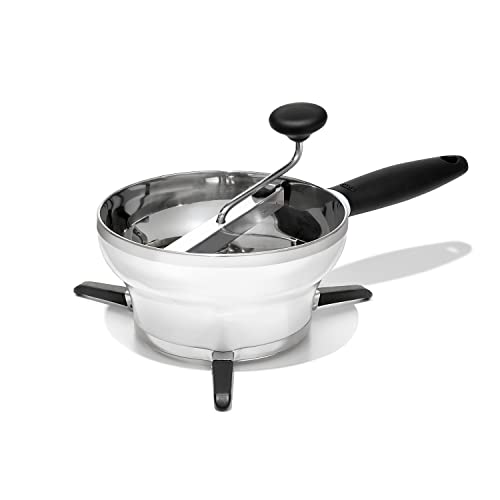
Best for: Home cooks making sauce, passata, or applesauce in normal batch sizes who want the job done fast with easy cleanup. Why it made the list: The three grinding discs cover everything from silky passata to chunky sauce, and the padded crank and non-slip legs remove the wobble and hand fatigue that make cheaper mills miserable.
- Key specs: Stainless steel bowl and discs, three interchangeable grinding plates from fine to coarse, soft comfort-grip crank knob, spring-loaded non-slip legs that fit most pots and bowls.
- What we like: The crank turns smoothly even through thick cooked tomatoes, the legs hold the mill steady over a wide range of pot sizes, and every part rinses or goes in the dishwasher.
- What we do not like: The working bowl is modest, so bushel-scale canning means many refills, and the plastic housing around the mechanism feels less permanent than all-metal classics.
- Who should buy it: Anyone making tomato sauce, salsa base, applesauce, or baby food in pot-sized batches a few times a month.
- Who should avoid it: High-volume canners processing cases of tomatoes at once, the Roma strainer’s continuous hopper will save them hours.
- Common complaints: Owners note that very fibrous loads need occasional reverse cranking to clear the disc, and that the legs can slide on very small saucepans.
- Size note: It sits securely on pots and bowls from roughly medium saucepan to stockpot width. If your sauce pot is enormous, mill into a separate bowl and transfer.
- Cleaning note: Rinse immediately after use before pulp dries in the disc holes, then run parts through the dishwasher. A quick brush under running water clears the fine disc fastest.
- Alternative: The RSVP Classic Rotary Food Mill offers a similar three-disc design in all stainless if you prefer zero plastic.
Food Mill Buying Guide
Disc options decide texture
A fine disc makes silky passata and strains out even small seeds, a medium disc is the workhorse for everyday marinara, and a coarse disc leaves rustic body for chunky sauces. Single-screen mills lock you into one texture forever, which is fine for one signature sauce but limiting if you also want applesauce or baby food.
Batch size changes the right answer
Rotary bowl mills like the OXO are perfect up to a stockpot of sauce, but they process one bowl at a time. If you can tomatoes by the bushel every summer, a hopper-fed strainer like the Roma feeds continuously and separates skins and seeds out one chute while sauce pours from another, cutting processing time dramatically.
Stability and crank comfort
You will crank for longer than you expect, so a padded knob and a mill that locks onto the pot matter more than they sound. Spring-loaded legs or hooked tabs should grip the rim firmly, because a mill that spins or rocks turns saucemaking into a two-person job.
Safety Notes
- Let cooked tomatoes cool briefly before milling, splashes from scalding sauce are the most common injury with these tools.
- Make sure the mill is locked and stable on the pot before cranking, a tipped mill dumps hot pulp.
- Keep fingers clear of the disc while cranking and never reach in to clear a clog while the handle is moving.
- Wash discs promptly, dried pulp hardens in the perforations and encourages people to poke at sharp edges with bare fingers.
What to Avoid
- Single-screen mills with folding wire cranks, they flex and skip under thick pulp.
- Mills with painted or coated steel that chips into food after a season of use.
- Models with no pot grips at all, stability is half the tool.
- Tiny novelty mills, tomato work needs bowl capacity or you will refill endlessly.
FAQ
Do I need to peel and seed tomatoes before using a food mill?
No, and that is the whole point. Cook the tomatoes down until soft, then ladle everything into the mill, skins, seeds, and all. The disc holds back skins and seeds while the pulp and juice pass through, so you skip blanching and peeling entirely.
Is a food mill better than a blender for tomato sauce?
For sauce, yes. A blender pulverizes seeds and skins into the sauce, which adds bitterness and a grainy, foamy texture. A food mill removes them instead, producing a smoother, cleaner-tasting sauce. The blender wins only when you want to use absolutely everything and do not mind the texture.
Which disc should I use for tomato sauce?
Start with the medium disc for everyday sauce, it balances smoothness with body and clogs least. Use the fine disc for passata or silky soup, and expect to crank a little harder. The coarse disc suits chunky garden sauces where you want visible texture.
Final Verdict
The OXO Good Grips Food Mill is the best food mill for tomatoes with its three discs and stable, comfortable design, while the VKP Brands Roma Food Strainer is the value workhorse for canning season and the Foley Stainless Food Mill keeps the classic budget option alive.
