The Breville Citrus Press Pro is the best electric citrus juicer, because its active-arm press and one-size-fits-all cone extract noticeably more juice from oranges, lemons, and grapefruit than spinning-reamer designs, with almost no forearm effort. If you juice citrus a few times a week, the difference between a press and a basic reamer is real: less bitter pith in the glass, drier spent halves, and a machine you will actually keep using.
The Breville Citrus Press Pro is the best electric citrus juicer, with a press-style arm that extracts more juice with less effort than any reamer. The Cuisinart Pulp Control Citrus Juicer is the best value for everyday orange juice with adjustable pulp.
- Best overall: Breville Citrus Press Pro
- Best value: Cuisinart Pulp Control Citrus Juicer
- Best budget: BLACK+DECKER 34 Ounce Citrus Juicer
- Avoid: Centrifugal juicers for citrus-only use, since they waste peel-heavy fruit and are harder to clean
Affiliate Disclosure: As an Amazon Associate, we earn from qualifying purchases. This does not affect our product rankings or recommendations.
Quick Picks
- Best overall: Breville Citrus Press Pro, A die-cast press that gets maximum juice with minimum effort and pith.. Check price on Amazon
- Best value: Cuisinart Pulp Control Citrus Juicer, Auto-reversing reamer and three pulp settings at a very fair price..
- Best budget: BLACK+DECKER 34 Ounce Citrus Juicer, A simple pitcher-style juicer that handles big batches cheaply..
Comparison Table
| Citrus juicer | Design | Best for | Pulp control | Buy |
|---|---|---|---|---|
| Breville Citrus Press Pro | Active-arm press, one universal cone | Daily juicers, grapefruit fans | Stainless filter, low pith | Check Price |
| Cuisinart Pulp Control | Auto-reversing reamer | Everyday orange and lemon juice | Three pulp settings | Check Price |
| BLACK+DECKER 34 Ounce | Reamer with storage pitcher | Big batches for recipes and pitchers | Strainer basket, some pulp | Check Price |
| Hamilton Beach Electric Citrus Juicer | Compact reamer | Occasional lemons and limes | Fixed strainer | Check Price |
How We Chose These Electric Citrus Juicer Picks
We compared press and reamer designs across the major small-appliance brands, looking at extraction efficiency, cone sizing, pulp management, and how easily each machine disassembles for cleaning. Owner feedback on motor longevity and juice yield weighed heavily in the rankings.
Key Takeaway: A press-style citrus juicer earns its higher cost only if you juice several times a week. For weekend orange juice, a well-built reamer like the Cuisinart delivers most of the result for far less.
Best Overall: Breville Citrus Press Pro
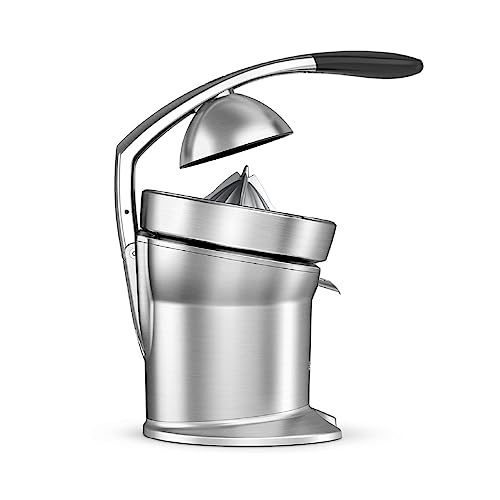
Best for: Households that juice citrus most mornings and want maximum yield with the least effort and cleanup. Why it made the list: The die-cast press arm applies even downward pressure while the cone rotates, so the fruit does the work instead of your wrist, and the single universal cone handles everything from limes to grapefruit without swapping parts.
- Key specs: Die-cast metal body, active-arm press with a single universal juicing cone, stainless steel filter, drip-stop spout, dishwasher-safe parts.
- What we like: Yield is visibly better than reamer juicers, the pressed halves come out nearly dry, and the drip-stop spout means no puddle when you swap glasses.
- What we do not like: It is expensive for a single-purpose appliance, it takes up permanent counter space, and the press mechanism is overkill if you only juice a lemon now and then.
- Who should buy it: Daily fresh-juice drinkers, grapefruit lovers, and anyone with wrist or hand issues who struggles to press fruit onto a spinning reamer.
- Who should avoid it: Occasional juicers and small-kitchen owners, since the cost and footprint are hard to justify for a weekly glass of orange juice.
- Common complaints: A few owners report the plastic fruit dome discoloring with heavy grapefruit use, and some wish the juice spout sat higher to fit taller glasses underneath.
- Size note: It is taller and heavier than reamer juicers, so plan for it to live on the counter rather than in a cabinet.
- Cleaning note: The cone, filter, and collector rinse clean in seconds and are dishwasher safe. Rinse right after juicing so pulp never dries onto the filter.
- Alternative: If you want ninety percent of the convenience at a fraction of the cost, the Cuisinart Pulp Control Citrus Juicer is the smart pick.
Electric Citrus Juicer Buying Guide
Press versus reamer
A press squeezes the fruit downward onto a rotating cone, extracting more juice with less bitterness because the peel is never ground. A reamer relies on you pressing the fruit onto a spinning cone, which is cheaper and more compact but tires your hand on big batches and pulls more pith into the glass.
Cone sizing and auto-reverse
Small cones suit limes and lemons, large cones suit oranges and grapefruit. Machines with stacked or universal cones save you from juggling parts. Auto-reversing reamers, like the Cuisinart, alternate spin direction to dig more juice out of the membranes, a genuinely useful feature rather than a gimmick.
Capacity and cleanup
If you juice for recipes or pitchers, a model with a built-in measured container, like the BLACK+DECKER, saves transferring. Whatever you buy, count the parts that touch juice: fewer, dishwasher-safe pieces is the single best predictor of whether you will still use the machine in a year.
Safety Notes
- Unplug the juicer before disassembling or reaching near the drive shaft.
- Wash all juice-contact parts after every use, since citrus sugars grow mold quickly in crevices.
- Do not run the motor continuously beyond the duty cycle in the manual, as small citrus motors overheat on marathon batches.
- Watch fingers around the spinning reamer, and never let children operate it unsupervised.
What to Avoid
- Buying a centrifugal or masticating juicer just for citrus, which wastes money and cleanup time.
- Models where the strainer cannot be removed, since dried pulp clogs them permanently.
- Pressing harder to speed things up on a reamer, which stalls the motor and grinds bitter pith.
- Leaving juice in an aluminum or reactive container, which picks up off flavors within hours.
FAQ
Is a press or reamer citrus juicer better?
A press extracts more juice with less effort and less bitter pith, which matters if you juice daily or handle big grapefruit. A reamer is cheaper, smaller, and completely fine for a few oranges or lemons a week. Match the machine to your frequency.
How many oranges make a glass of juice?
Roughly three medium oranges yield an eight-ounce glass, though a press-style juicer squeezes closer to that from two and a half. Valencia oranges yield the most juice, while navels run drier but sweeter.
Can electric citrus juicers handle grapefruit?
Yes, but check the cone size. Small fixed cones force you to grind a big grapefruit awkwardly around the edges. Presses with universal cones and reamers with a large cone attachment handle grapefruit halves cleanly.
Final Verdict
The Breville Citrus Press Pro is the best electric citrus juicer for daily use, with the Cuisinart Pulp Control Citrus Juicer delivering excellent everyday juice with adjustable pulp for far less, and the BLACK+DECKER 34 Ounce Citrus Juicer covering batch juicing on a budget.
