The CDN High Heat Oven Thermometer is the best oven thermometer for baking because it reads accurately across the full baking range, has a large easy to read dial through a closed oven door, and both hangs from a rack and stands on its base. Most home ovens run 15 to 50 degrees off their set temperature, which is the hidden reason cookies burn and cakes sink. A reliable dial thermometer costs little and immediately tells you what your oven is actually doing, including where its hot spots are.
The CDN High Heat Oven Thermometer is the best choice for bakers, combining proven accuracy with a dial you can actually read through the door. The Rubbermaid Commercial oven thermometer is the value workhorse trusted in restaurant kitchens.
- Best overall: CDN High Heat Oven Thermometer
- Best value: Rubbermaid Commercial Oven Monitoring Thermometer
- Best budget: Taylor Large Dial Oven Thermometer
- Avoid: Tiny dial thermometers you cannot read without opening the door
Affiliate Disclosure: As an Amazon Associate, we earn from qualifying purchases. This does not affect our product rankings or recommendations.
Quick Picks
- Best overall: CDN High Heat Oven Thermometer, Accurate, high range dial that is legible through a closed oven door. Check price on Amazon
- Best value: Rubbermaid Commercial Oven Monitoring Thermometer, The restaurant kitchen standard, durable steel and glass at a fair price.
- Best budget: Taylor Large Dial Oven Thermometer, Basic but dependable dial for checking oven honesty on a tight budget.
Comparison Table
| Thermometer | Dial size | Best for | Mounting | Buy |
|---|---|---|---|---|
| CDN High Heat | Large 2 inch class dial | Serious bakers, high heat baking | Hangs or stands | Check Price |
| Rubbermaid Commercial | Standard dial | Everyday accuracy, durability | Hangs or stands | Check Price |
| Taylor Large Dial | Extra large dial | Easy reading on a budget | Hangs or stands | Check Price |
| KitchenAid Dial Oven Thermometer | Standard dial | Matching a mainstream brand, gifting | Hangs or stands | Check Price |
How We Chose These Oven Thermometer Picks
We compared stated accuracy, temperature range, dial legibility, and mounting options across the most widely available oven thermometers, then weighed aggregated owner feedback on calibration drift, fogged lenses, and how each unit survives months of continuous oven heat.
Key Takeaway: Your oven dial is a suggestion, not a measurement. Leave a quality dial thermometer in the center of the middle rack for a week and you will learn more about your baking failures than any recipe tweak will teach you.
Best Overall: CDN High Heat Oven Thermometer
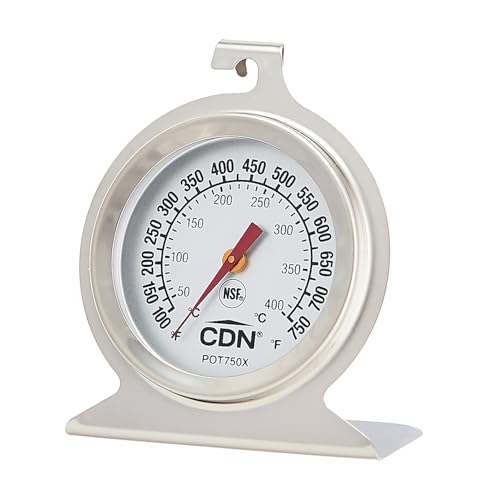
Best for: Bakers who want to verify true oven temperature at a glance, including at the high temperatures used for bread, pizza, and pastry. Why it made the list: CDN builds instruments for professional kitchens, and this dial reads reliably where cheap thermometers drift, at the top of the baking range. The face is large and high contrast enough to read through oven glass, which matters because opening the door drops oven temperature significantly every time you check.
- Key specs: Stainless steel body, glass lens, wide temperature range covering everything from proofing warmth to high heat pizza baking, dual hanging hook and flat base, durable bimetal coil movement.
- What we like: Consistent accuracy out of the box, a face you can read through the door, and a body that shrugs off months of living inside a hot oven without fogging or discoloring.
- What we do not like: It costs more than throwaway dials, and like all bimetal thermometers it responds slowly, taking a couple of minutes to settle on big temperature swings. It cannot log or alert like a probe unit.
- Who should buy it: Anyone whose bakes come out inconsistent, anyone with an older oven, and bread or pizza bakers pushing high temperatures where oven dials lie the most.
- Who should avoid it: Cooks who want alerts on their phone or precise digital logging. An oven probe system with a wired sensor serves that need, a dial thermometer is a simpler always on reference.
- Common complaints: A small number of owners receive units reading a few degrees off, which is easy to verify against a known reference. Slow response on preheat is the other recurring note, inherent to the coil design.
- Size note: The dial and base are compact enough to sit on any rack without blocking a sheet pan. Hang it from the center of the middle rack for the most representative reading.
- Cleaning note: Wipe with a damp cloth once cool. Do not submerge it or run it through the dishwasher, moisture inside the lens is the most common way these die.
- Alternative: The Rubbermaid Commercial oven thermometer delivers most of the same accuracy in a plainer package and has decades of restaurant use behind it.
Oven Thermometer Buying Guide
Why ovens lie
Home ovens regulate temperature by cycling elements on and off, and the factory sensor often sits far from where your food is. Swings of 25 degrees around the set point are normal, and miscalibration adds a fixed offset on top. A rack level thermometer shows the temperature your food actually experiences.
Dial versus digital probe
Bimetal dial thermometers are inexpensive, need no batteries, and live in the oven permanently. Digital probe systems respond faster and can alert you, but cost more and their cables are one more failure point. For diagnosing an oven and everyday baking, a dial is the right first purchase.
Finding your hot spots
Move the thermometer to different rack positions and corners across several bakes, ovens commonly run hotter at the back and top. Once you map the pattern, you can rotate pans purposefully instead of guessing, which fixes most uneven browning problems.
Safety Notes
- Use oven mitts when repositioning a thermometer, the steel body holds heat long after the door opens.
- Do not use a standard oven thermometer during self clean cycles, the extreme heat can destroy it.
- Keep glass lens thermometers away from direct broiler elements.
- Verify a new thermometer against a second reference before recalibrating your oven around it.
What to Avoid
- Small dial faces you cannot read through the door, opening the oven to check defeats the purpose.
- Leaving the thermometer touching an oven wall, contact readings run hot and mislead you.
- Trusting the oven preheat beep, most ovens signal well before the interior fully stabilizes.
- Thermometers with painted faces that discolor, once the markings brown they become unreadable.
FAQ
Where should I put an oven thermometer for baking?
Center of the middle rack is the standard reference position, since that is where most recipes assume your food sits. After you have a baseline, move it around to map hot spots at the back corners and near the top element.
How far off can a home oven be?
Offsets of 15 to 50 degrees are common, and drift gets worse as ovens age. Many ovens also swing around the set point as elements cycle, so watch the thermometer across ten minutes rather than trusting one glance.
Can I calibrate my oven using a dial thermometer?
Yes, most ovens allow an offset adjustment through their settings, and a quality dial thermometer is accurate enough to set it. Check the reading at two different set temperatures before adjusting, and recheck every few months.
Final Verdict
The CDN High Heat Oven Thermometer is the best oven thermometer for baking, with the Rubbermaid Commercial as the proven value workhorse and the Taylor Large Dial covering budget buyers who just need the truth about their oven.
